As an Amazon Associate we earn from qualifying purchases.
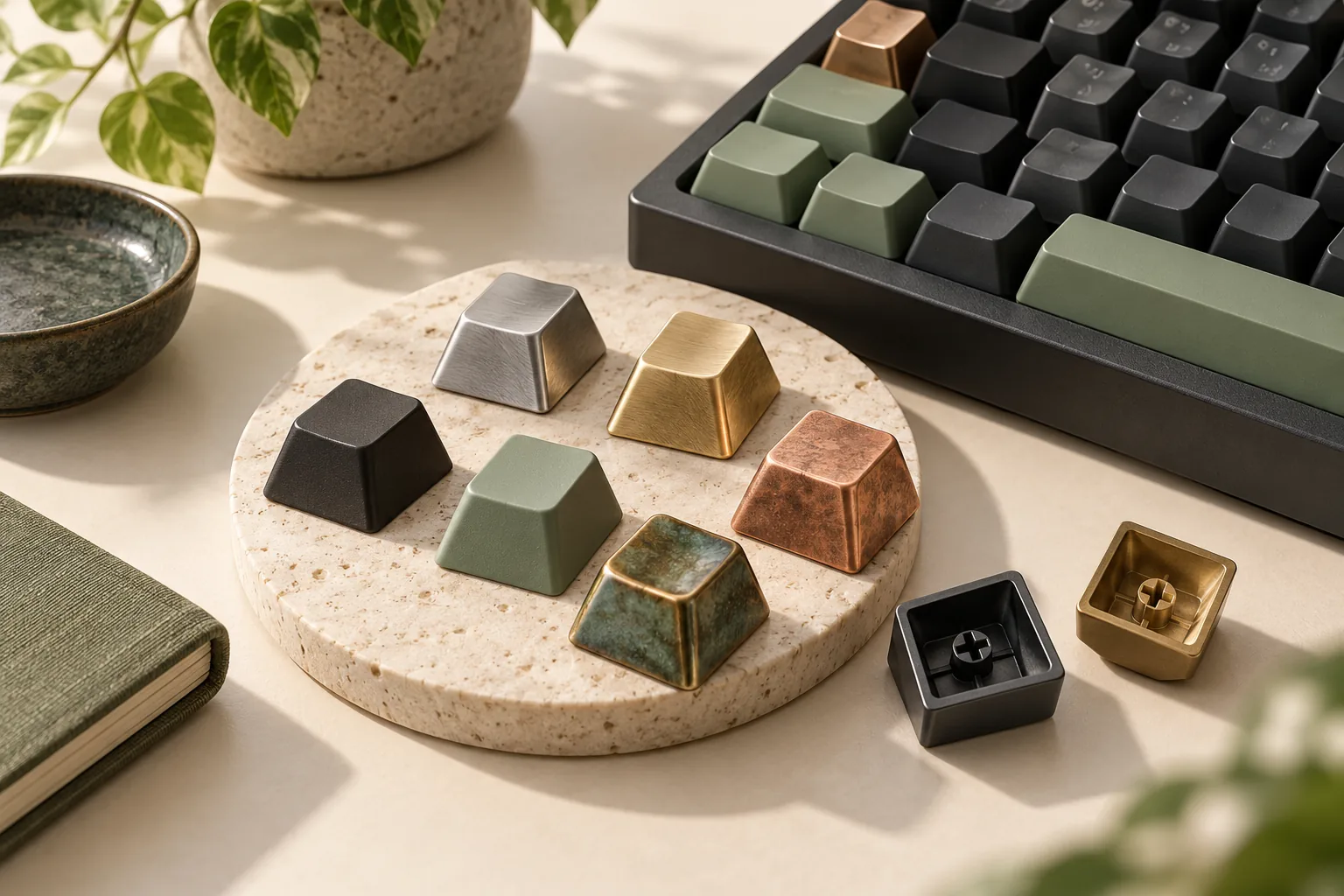
Choose aluminum keycaps, brass options, or copper finishes by checking the exact material specification, selected package, and physical fit. Start by deciding whether you want an accent key or a complete layout replacement. Then compare documented construction and coverage before making assumptions about weight, sound, or durability.
This guide is for mechanical keyboard owners comparing metal keycaps for an existing board. It focuses on material descriptions, Awekeys Copper Eagle kits, and the questions that determine whether a purchase is sufficiently documented.
Quick takeaways
- Aluminum: Escher Labs provides a concrete accent-key example described as solid 6061-T6 aluminum, although its row and profile labels require clarification. Escher Labs listing
- Brass: The same listing names a brass option; the available excerpt does not establish its exact alloy or finished mass. Escher Labs listing
- Copper: Awekeys describes Copper Eagle as recycled cupronickel with copper plating. That supports a copper surface over a different metal substrate. Awekeys product description
- Sets: Match every required key to the selected kit inventory before comparing purchase totals.
Research basis: This is a document-based buying guide, without hands-on testing. Sources were reviewed on October 15, 2026. The Escher Labs and official Awekeys material details are supported by search excerpts; the historical project post and Yanko Design article were available as page text.
On this page: Material comparison · Aluminum · Brass · Copper · Awekeys kits · Fit checks · Worksheet · FAQs
Compare the documented materials
For this comparison, separate the substrate—the material forming the keycap body—from its surface finish. Record the package contents separately. The available examples describe different purchases: an aluminum or brass accent option and an Awekeys project with base and add-on kits. Compare each against the job you want it to do. For one decorative position, apply the artisan accent-key checklist.
| Purchase example | What the source establishes | What to resolve before choosing |
|---|---|---|
| Escher Labs aluminum accent | Solid 6061-T6 aluminum; MX stem wording. Source | Selected finish, finished mass, exact row/profile, dimensions, and host fit |
| Escher Labs brass option | A separately named brass option. Source | Exact alloy, construction, surface treatment, mass, and care instructions |
| Awekeys Copper Eagle | Recycled cupronickel substrate with copper plating. Source | Selected kit contents, finished masses, physical fit, and finish-specific care |
Use this table to identify which questions remain open. It does not establish a weight, acoustic, or lifespan ranking among these products.
Aluminum keycaps: check the alloy and selected finish
Escher Labs' listing excerpt describes its aluminum keycap as machined from solid 6061-T6 aluminum. That is a specific construction statement you can record when comparing candidates. Keep it attached to this item rather than treating it as a specification for aluminum keycaps generally. Escher Labs listing
Ask the seller to identify the finish on the exact option you intend to order. Request a finished keycap mass and a dimensioned drawing or clear photographs of the underside. If lettering matters, ask how the legends—the printed or engraved characters—are made and whether the selected version includes them.
This candidate also illustrates why a detailed material description does not settle compatibility. Its title says “1u R1,” its URL includes “OEM R4,” and its excerpt uses “GMK” for the profile while naming an MX stem. Those labels do not resolve one exact row and profile. Obtain confirmation for the selected item before treating it as a matching replacement. Escher Labs listing
Brass keycaps: request a complete specification
The Escher Labs excerpt names brass as a separate option, but it does not identify a brass alloy. Its solid 6061-T6 aluminum wording should not be transferred to the brass selection. Treat the brass option as a candidate requiring its own specification. Escher Labs listing
Request the body material, whether any plating or clear coating is present, and the finished mass of the actual key. Ask for care instructions tied to that surface treatment. If your goal is a particular appearance, request photographs of the selected finish and legend combination.
Choose the brass option when its documented construction and appearance meet your requirements and the fit questions are resolved. If your priority is a guaranteed typing or sound improvement, the evidence here cannot establish that outcome. Keep those expectations separate from the decision to buy a particular material or finish.
Copper keycaps: separate the substrate from the surface
Awekeys Copper Eagle provides the clearest material distinction in this comparison. The official product excerpt describes recycled cupronickel keycaps with copper plating. The supported description is therefore a cupronickel body with a copper surface; it does not establish a pure solid-copper keycap. Awekeys product description
That distinction helps you ask a more useful purchase question: do you want this plated construction, or is solid copper a requirement? If solid copper is essential, this description does not meet that requirement. If the plated Copper Eagle construction suits your goal, continue to the kit and fit checks.
Finish longevity remains a separate question. Sarang Sheth's July 31, 2024, Yanko Design article reports a protective nanocoating but explicitly leaves its long-term durability undetermined. Treat that as historical reporting, without converting it into a wear guarantee. Yanko Design coverage
Before purchase, request manufacturer-approved care instructions for the exact finish. Establish whether polishing is permitted and which cleaning methods the manufacturer recommends before applying any treatment.
Awekeys metal keycaps: check the selected package
The April 25, 2024, ClickClack.io group-buy post identifies Copper Eagle as an Awekeys-manufactured project with Cherry profile and recycled metal. It separately lists a Base Kit, Novelties, an Alice Add-On Pack, and a 7U Add-On Pack. Those are historical kit names, not confirmation of what a current selection includes. Original Geekhack project post Use the group-buy ordering checks to evaluate a present offer separately from that historical post.
The distinction matters when you are searching for a full metal keycaps set. Require a current inventory for the exact package selected, including every key size and row you need. A project name or broad product title is insufficient for that comparison.
Choose the purchase scope first:
- Single accent: Verify the one intended key position and its selected material and finish.
- Small pack: Match each included key to a planned position.
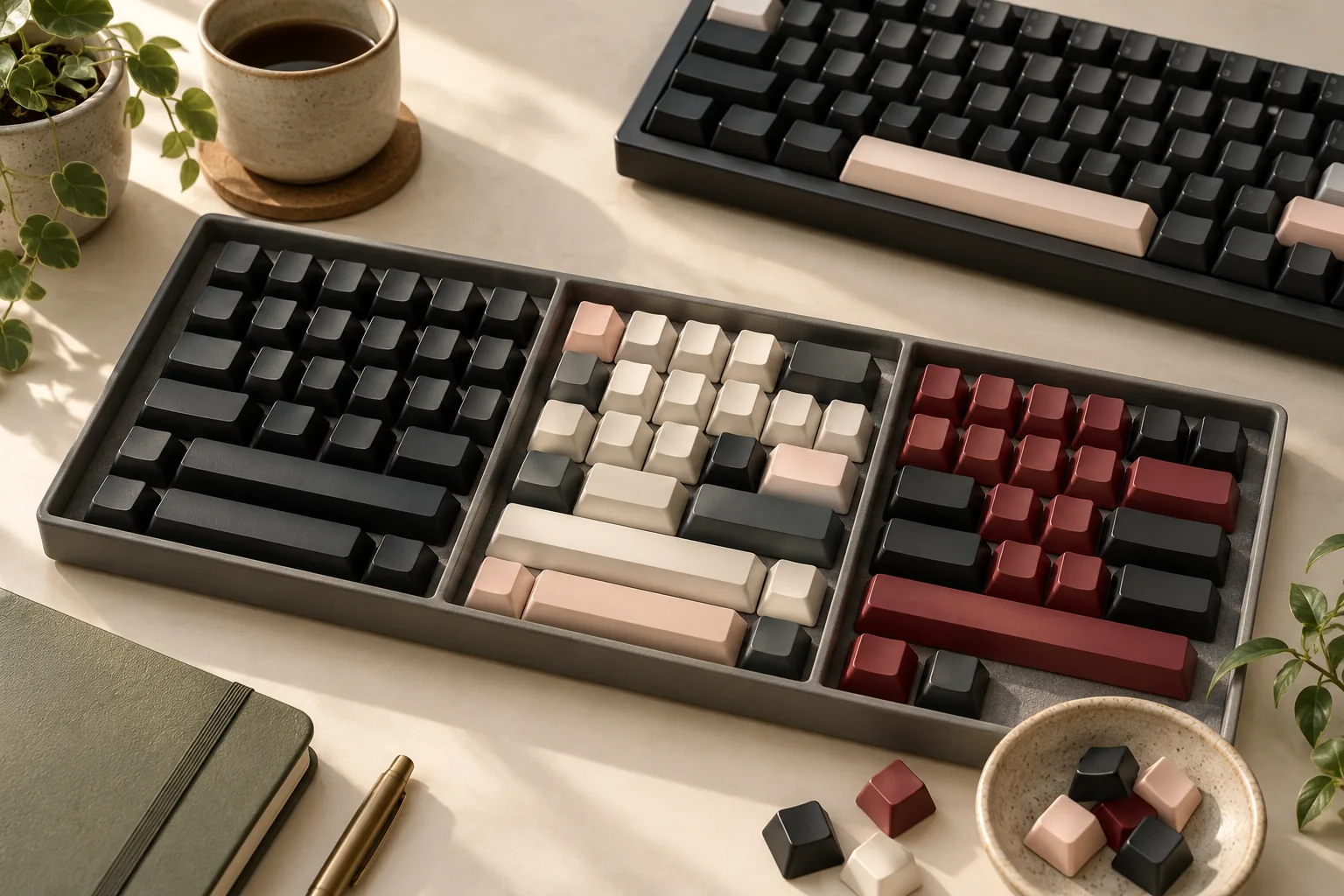
- Base kit: Compare the full inventory with your layout and identify any missing keys.
- Base plus add-ons: Confirm which additional keys each pack supplies and whether any required positions remain uncovered.
For example, suppose your layout requires a 7u spacebar. The historical existence of a 7U Add-On Pack gives you a specific package to ask about. It does not prove that today's base selection includes that spacebar or that the add-on's entire contents fit your board. Request the current kit diagram and mounting details. Historical kit record
Build the complete package list before comparing totals. Use the selected items and checkout details rather than historical group-buy prices or an unspecified starting price.
Verify physical fit and switch return
Use the following checks as a verification process. They are questions to resolve with documentation or a permitted trial, rather than measured compatibility results for these products.
Match the stem, row, and key width
Start with your exact switch model and ask the keycap maker to confirm the intended interface. Escher Labs' MX stem wording supplies one specification field, while its conflicting row and profile labels leave others unresolved. Request confirmation that addresses those fields separately. Escher Labs listing
Create a position-by-position list using your keyboard's layout documentation. Record the required width, row, profile, and legend for each replacement. For a full set, compare that list with the selected kit diagram and flag every mismatch or missing entry.
Check the underside and stabilized keys
Ask for underside photographs or drawings showing the stem and, where applicable, stabilizer mounting points. For a spacebar or other stabilized key, request confirmation against your board's mounting arrangement. Keep this check separate from the visible shape and top-side appearance. The spacebar coverage guide helps record the required arrangement.
Ask how stem fit is specified and whether the manufacturer has verified the keycap on your exact switch model. Obtain installation and removal guidance before attempting a trial. Do not use force as a substitute for resolving an uncertain fit.
Request mass and return evidence
Ask for finished mass by key size, especially for the specific accent or stabilized key you intend to use. Then ask whether the maker has checked reliable switch return with your switch and spring configuration. A material name alone does not provide the missing product measurements.
If a trial is available under the seller's stated terms, follow the installation guidance and check that the key moves freely and returns after release. Treat binding, incomplete return, or contact with neighboring parts as reasons to stop and investigate. This is a proposed acceptance check; no return threshold or successful test result is established here.
Use this purchase worksheet
Complete a separate copy for each selected item or package. Record unanswered questions explicitly so they remain visible while you compare options.
| Field | What to record or request |
|---|---|
| Purchase scope | Accent, small pack, base kit, or base plus named add-ons |
| Body material | Exact substrate and alloy, where specified |
| Surface | Plating, coating, or other finish for the selected option |
| Legends | Included characters, production method, and photographs |
| Mount | Stem specification and confirmation for your switch model |
| Geometry | Row, profile, width, underside dimensions, and mounting locations |
| Coverage | A matching supplied key for every intended position |
| Finished mass | Mass for the relevant key sizes and selected construction |
| Return evidence | Tested switch configuration, conditions, and reported result |
| Care | Manufacturer-approved instructions for the selected finish |
| Checkout | Exact package contents, delivered total, and applicable seller terms |
Resolve gaps according to your goal. For an accent purchase, focus first on the intended position, its interface, and its selected finish. For a layout replacement, settle the complete inventory before comparing package totals.
A useful seller message is: “Please confirm the substrate, finish, finished mass, row/profile, stem interface, and underside dimensions for this selected item. For my layout, please identify the exact kits required and provide the current kit diagram and care instructions.” Include your keyboard layout and switch model so the seller can address the actual configuration.
Frequently asked questions
Are Copper Eagle keycaps solid copper?
The official Awekeys excerpt describes recycled cupronickel with copper plating. That supports copper on the surface over a cupronickel body, rather than pure solid copper throughout. If solid copper is a purchase requirement, request a different product specification that explicitly establishes it. Awekeys description
Does an MX stem label prove the whole keycap fits?
Treat it as one field to verify. The Escher Labs example names an MX stem but has unresolved row and profile labels. Confirm the exact item, dimensions, intended position, and switch configuration before deciding it is a matching replacement. Escher Labs listing
Which metal will sound best or last longest?
This comparison does not establish a winner. It has no matched acoustic, switch-return, or finish-wear test for these options. Yanko Design also leaves Copper Eagle's reported coating durability unresolved. Choose on documented construction and fit, and request suitable test evidence for any promised performance outcome. Yanko Design coverage
Choose the documented package
For aluminum keycaps, retain the exact alloy statement and resolve the finish and fit details. For brass, obtain the missing construction specification. For Copper Eagle, evaluate the documented copper-plated cupronickel construction and match the selected kits to your layout.
Your next step is to complete the worksheet for one candidate and send its unresolved questions to the maker. Use the Escher Labs listing or official Awekeys product page to identify the exact item you want confirmed.