As an Amazon Associate we earn from qualifying purchases.
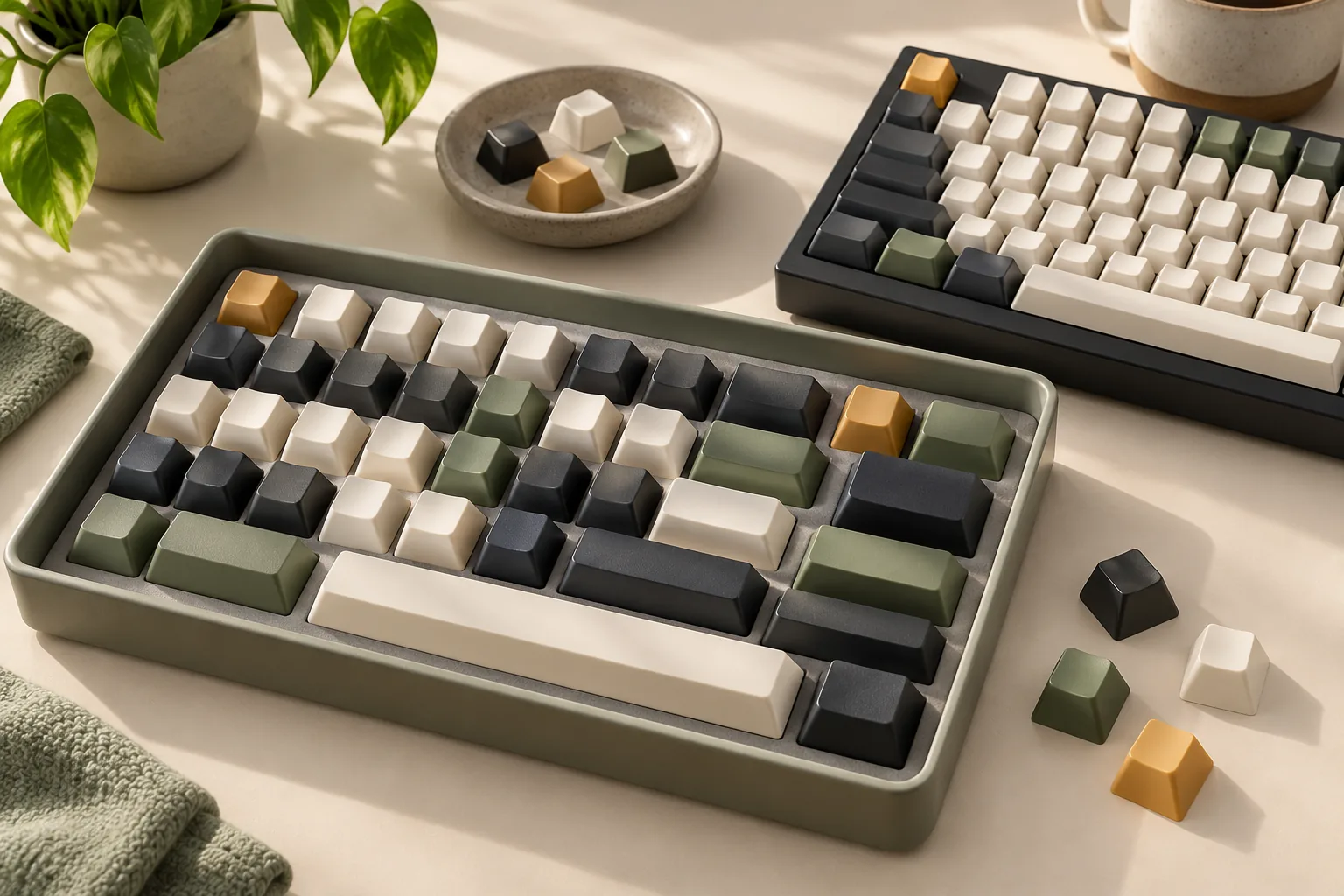
Choose PBT keycaps by checking the material, legend process, profile, and exact keys included. Then verify each required key’s row, width, mounting interface, and stabilizer arrangement against your keyboard’s documentation. Use the selected kit diagram to establish coverage before ordering.
This guide is for mechanical keyboard owners choosing replacement keycaps. It explains the product terms, compares documented examples, and provides a worksheet for checking a complete set.
Quick buying checklist
- Confirm PBT material and the documented legend process.
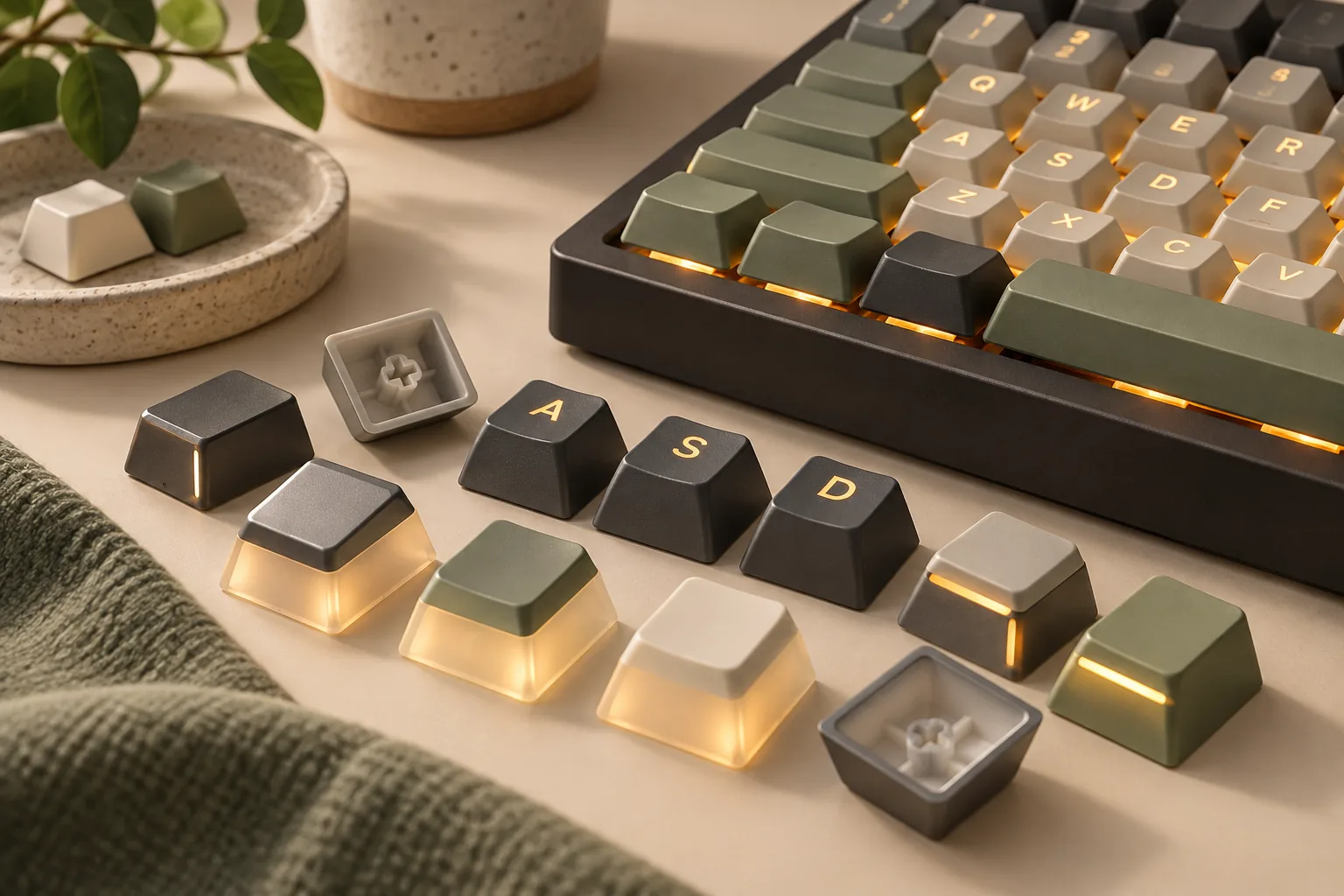
- Check shine-through support separately if backlighting matters.
- Match required keys by size and row.
- Verify mounting and stabilizer details.
- Resolve every missing specification before buying.
In this guide: PBT basics · Legend methods · Cherry profile · Coverage worksheet · Product examples · Quality checks · FAQs · Final buying check
Editorial method: This guide compares manufacturer documentation captured on October 15, 2026. The product examples illustrate published specifications; they were not tested for this guide.
What are PBT keycaps?
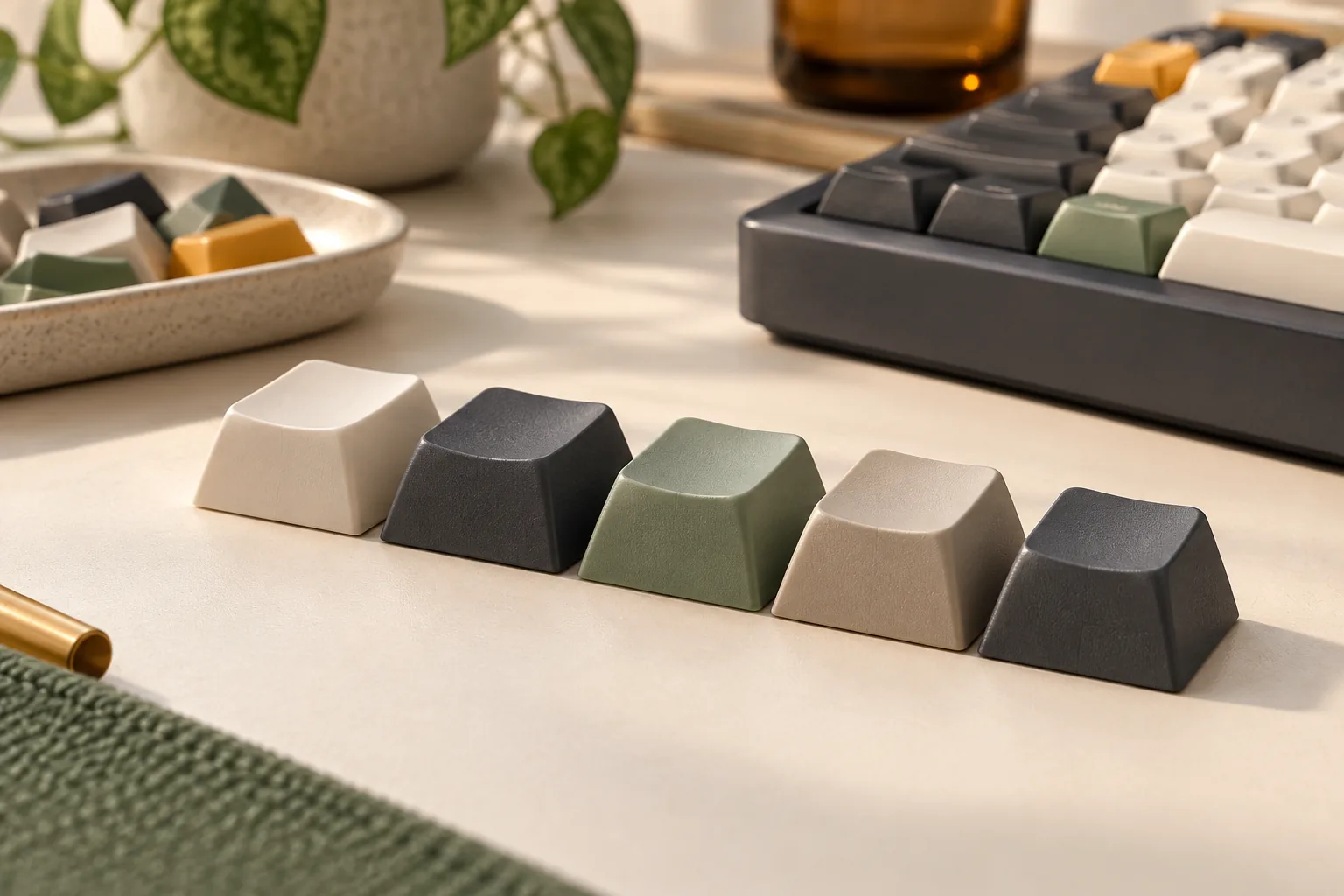
PBT keycaps are keyboard keycaps made from polybutylene terephthalate plastic. PBT identifies the material; double-shot and dye-sublimation identify ways of producing legends—the letters, numbers, or symbols on the keys. Profile and kit contents are separate specifications that also need checking. Kinetic Labs’ June 10, 2022 process article explains these distinctions.
Read a listing as a collection of separate fields. “PBT” answers the material question. “Double-shot” answers the legend-process question. A profile name describes the keycap shape, while the kit drawing should show which sizes and rows are supplied.
That separation makes shopping more precise. A listing can satisfy your material preference while leaving a necessary key or mounting detail unresolved. Keep those unanswered questions visible as you compare sets.
Double-shot PBT keycaps versus dye-sub
Kinetic Labs describes double-shot production as molding separately colored plastics for the keycap and its legend. It describes dye-sublimation, often shortened to dye-sub, as transferring dye pigment into the plastic to create legends or artwork. These descriptions explain the processes; they do not establish a universal quality ranking. Source: Kinetic Labs.
| Buying question | Double-shot PBT | Dye-sub PBT |
|---|---|---|
| How is the legend produced? | Separately colored plastics are molded into the keycap and legend. | Dye pigment is transferred into the plastic. |
| What should you inspect? | Close-up images of the exact set’s lettering and symbols. | Close-up images of the exact set’s lettering and artwork. |
| What proves your required keys are included? | The selected kit’s layout diagram. | The selected kit’s layout diagram. |
| What confirms shine-through support? | A specific statement for that set. | A specific statement for that set. |
Choose double-shot when you specifically want molded legends and the documented kit meets your other requirements. Choose dye-sub when its lettering or artwork suits your preferences and its kit supplies the keys you need. Neither process label resolves profile, mounting, or complete layout coverage.
Check backlight transparency separately
If you want lighting to pass through the legends, ask whether the exact selected set supports that effect. A double-shot label alone should not be treated as confirmation. Kinetic Labs’ process explanation makes light transmission conditional on the plastic used for the legends. Source: Kinetic Labs.
Make this a separate line in your comparison notes: “Shine-through confirmed for this version?” If the listing leaves it unclear, request clarification before choosing on that basis.
Choosing Cherry-profile PBT keycaps
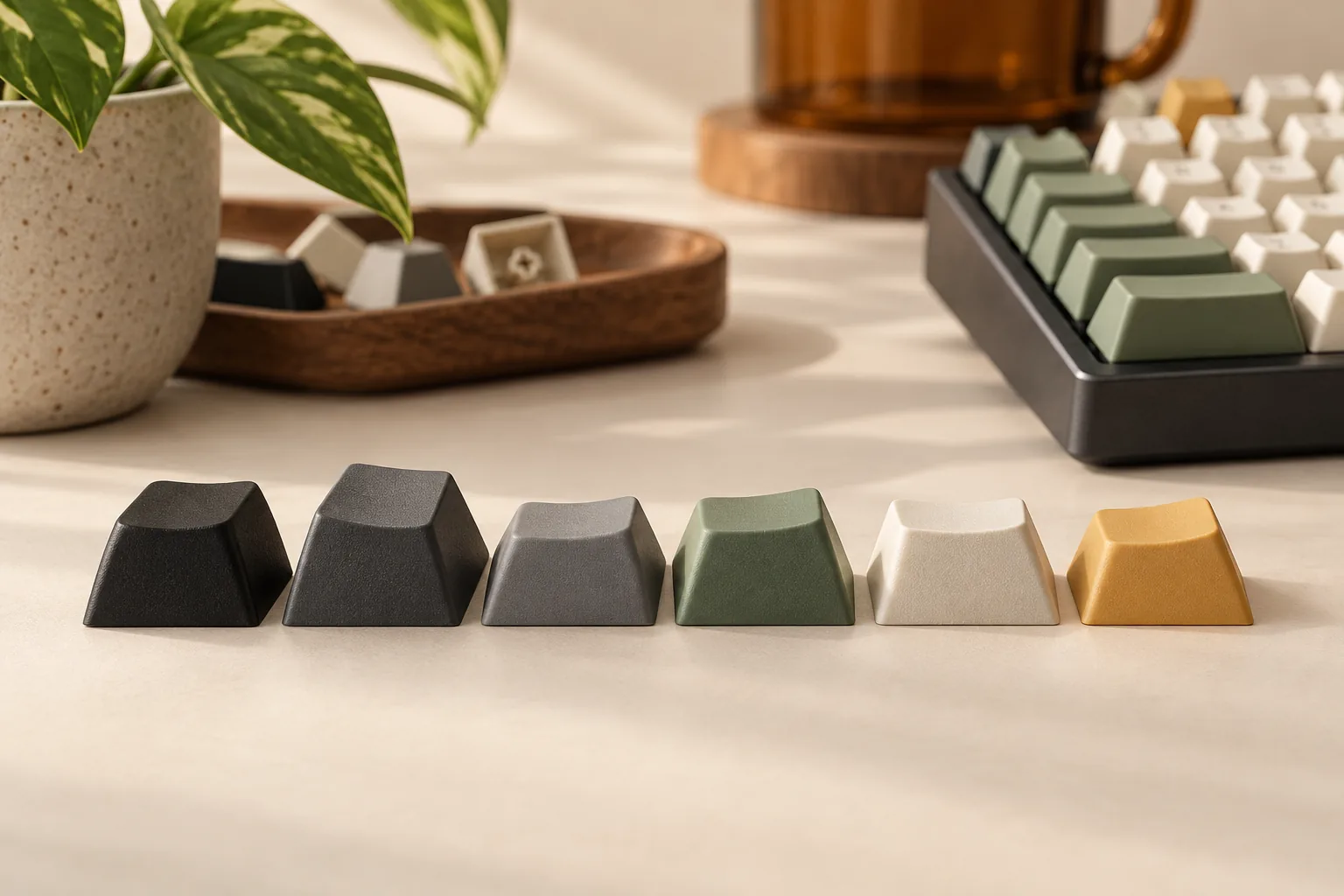
For Cherry-profile shopping, compare both key size and row. Kinetic Labs’ 2022 article explains that its Cherry-profile molds differ by size, legend, and row. The same article directs buyers to individual kit layouts and notes that dye-sub sets can have different key counts and layouts. Source: Kinetic Labs.
Start with the keys whose positions you need to confirm most carefully. Locate each one in the kit drawing, then compare its width and row designation with your keyboard’s requirements. A matching label is only one part of that check. Use the keycap profile and row comparison when the row designation is unclear.
Keep the profile and mounting checks separate. Record the advertised profile, then obtain documentation for the keycap-to-switch interface and any required stabilizer connections. Do not use a profile name to fill in an unspecified mounting detail.
Also keep historical specifications attached to their original product versions. The profile described in an older article should not supply a missing profile specification for a later revision.
Complete-key coverage worksheet
Build your requirements list from your keyboard’s exact model, layout, and revision. Use its documentation alongside the selected keycap kit diagram. Where either document leaves a necessary detail unclear, ask the manufacturer or seller for clarification.
Record a separate entry for every required key. The groups below organize the work; they do not replace an individual-key inventory. This approach follows the row-and-size distinctions in Kinetic Labs’ process article and accounts for conditions such as Corsair’s standard-bottom-row requirement.
| Key or specification | Record from your keyboard | Confirm in the selected kit |
|---|---|---|
| Product identity | Exact keyboard model, revision, and layout | Exact keycap product, SKU, revision, and selected kit |
| Letters, numbers, and symbols | Every required key and legend | Each key is supplied in the needed size and row |
| Function keys and arrows | Required positions and legends | Corresponding keys and documented rows |
| Spacebar | Required width, mounting interface, and stabilizer arrangement | A matching spacebar with documented underside details |
| Left and right Shift | Each key’s width and row | Both required versions are included |
| Bottom-row modifiers | Every position, legend, width, and row | A match for each position |
| Enter, Backspace, and Tab | Required shapes, widths, and rows | Each required key is shown |
| Navigation keys | Each key’s position, width, and row | The correct version for each position |
| ISO requirements, if applicable | Required Enter, Shift, and nearby keys | Every necessary shape and legend is documented |
| Numpad or other additional keys | Every extra key you intend to replace | Required keys are included in the selected kit |
| Mounting and stabilizers | Documented connection requirements | Matching technical details or written confirmation |
| Backlit legends, if desired | Your lighting requirement | Explicit support for the exact selected set |
Use the manufacturer’s dimensions and row labels consistently. Save the kit diagram with your notes so that a later change of color, regional version, or kit selection prompts another check.
Worked example: a key is present, but its row is unclear
Suppose a kit drawing includes the navigation-key label you need and confirms its width, but does not identify its row. Record the width as confirmed and the row as unresolved. Ask for the row information rather than treating the matching legend as complete proof.
Apply the same approach to a spacebar whose width is listed but whose underside connections are unspecified. If any required key remains unverified, pause the order and request the missing documentation.
Two documented PBT keycap set examples
These examples show how to compare published fields without declaring either set compatible with a particular keyboard. Specifications below come from the Whale PBT V4 listing and the Corsair CH-9911020-NA listing, captured on October 15, 2026.
| Documented field | Kinetic Labs Whale PBT V4 | Corsair PBT DOUBLE-SHOT PRO, ORIGIN Red (NA) |
|---|---|---|
| Product identifier | Whale PBT Keycaps V4 | CH-9911020-NA |
| Listed key count | 175 keys | 104 keys |
| Material description | Thick PBT | Double-shot PBT |
| Legend process | Dye-sub | Double-shot |
| Novelty keys | 13 novelty art keys listed as included | Not established in the cited text |
| Accessories | Not established in the cited V4 text | 120 O-ring dampeners, keycap puller, quick-start guide, and warranty card |
| Exact profile and individual-key row map | Not established in the cited product text | Not established in the cited product text |
| Exact mounting and stabilizer geometry | Not established in the cited product text | Not established in the cited product text |
| Fit for your particular keyboard | Requires individual-key verification | Requires individual-key verification |
Whale V4’s listing uses broad compatibility language about fitting most boards. That statement does not establish the exact keys, rows, or underside geometry required by your keyboard. Use the 175-key count to describe the package, then request the kit diagram to assess coverage. Source: Whale V4.
Corsair states compatibility with its mechanical and optical-mechanical keyboards that have a standard bottom row. Preserve that condition when checking a Corsair model. It does not establish compatibility with every optical keyboard, and the 104-key package count does not prove coverage for every compact or nonstandard layout. Source: Corsair CH-9911020-NA. The Corsair model-specific replacement guide helps apply that condition to the exact keyboard.
Why the revision check matters
Kinetic Labs’ June 10, 2022 article describes Whale among its 147-key double-shot sets. The Whale V4 product page captured in October 2026 instead lists 175 keys and dye-sub legends. Those specifications belong to different descriptions and must stay separate. Historical article · Whale V4 listing.
When reading an older review, first check which version it covers. Use it only for specifications documented for that version. Obtain V4’s own kit documentation before assigning it a profile, mounting interface, or layout fit.
Checking thickness, texture, and molding
Treat descriptive language as a starting point for questions. Kinetic Labs calls Whale V4 “thick PBT,” while Corsair describes a textured surface for its kit. These are manufacturer descriptions, not standardized measurements or independent comparisons. Whale V4 · Corsair CH-9911020-NA.
If thickness matters to your purchase, request a numerical specification for the selected version. Examine close-up photographs for lettering alignment and clarity, and ask what support is available for missing or defective caps. For molding concerns, seek evidence about the actual product revision rather than inferring quality from PBT material alone.
Keep sound and feel expectations separate from documented specifications. This comparison provides no measured basis for ranking these sets by sound, durability, shine resistance, or molding consistency.
Frequently asked questions
Are double-shot PBT keycaps always shine-through?
Do not assume shine-through support from the double-shot label. Double-shot describes how the keycap and legend are molded. Kinetic Labs’ explanation makes light transmission conditional on the legend plastic, so confirm backlit-legend support for the exact set and revision you select. Source: Kinetic Labs.
Does a larger PBT keycap set guarantee better coverage?
A higher count does not establish a match for every required key. Check the kit diagram for the sizes, rows, and legends your keyboard needs, then confirm mounting details. The documented 175-key Whale V4 package still needs that individual-key check. Source: Whale V4.
How do I choose the best PBT keycaps for my keyboard?
Start with complete, documented coverage for your exact keyboard. Among sets that pass that check, compare the legend process, advertised profile, appearance, and any confirmed lighting support. Use the worksheet to keep unresolved details visible; avoid choosing a set solely because its listing calls it a full set.
Before you order
Open the official page for your selected product and complete one final check:
- Identity: Does the SKU, revision, regional version, and selected kit match your notes?
- Coverage: Is every required key confirmed by size, row, mounting interface, and stabilizer arrangement?
- Preferences: Are the legend process, profile, and any desired shine-through support documented?
- Seller terms: Have you checked the current price, availability, shipping, return conditions, and missing-key support for your order?
Choose PBT keycaps once the essential fit questions are resolved. Your next step is to obtain the exact kit diagram and match it against your completed key inventory.