As an Amazon Associate we earn from qualifying purchases.
Choose artisan keycaps by verifying the exact maker and edition, then checking the stem connection, intended key position, sculpt height, and surrounding clearance. A galaxy theme or an MX label alone does not establish fit. The best candidate is the piece whose identity and dimensions you can confirm for your particular keyboard.
This guide is for buyers choosing one decorative accent key for a keyboard they already own. It uses maker information captured on October 15, 2026, with no hands-on installation, sound, or durability testing. Keychron’s details come from an official product search excerpt; the Jelly Key and Claybies examples use captured maker-page text.
Quick takeaways
- Choose the exact keycap variant before evaluating its specifications.
- Verify maker-specific markings and edition details, especially for a secondhand purchase.
- Keep stem compatibility and physical clearance as separate checks.
- Get care instructions and current order terms for the individual item.
On this page: Exact object · Comparison · Maker verification · Fit card · Care · Seller terms · FAQ
Start with the exact object
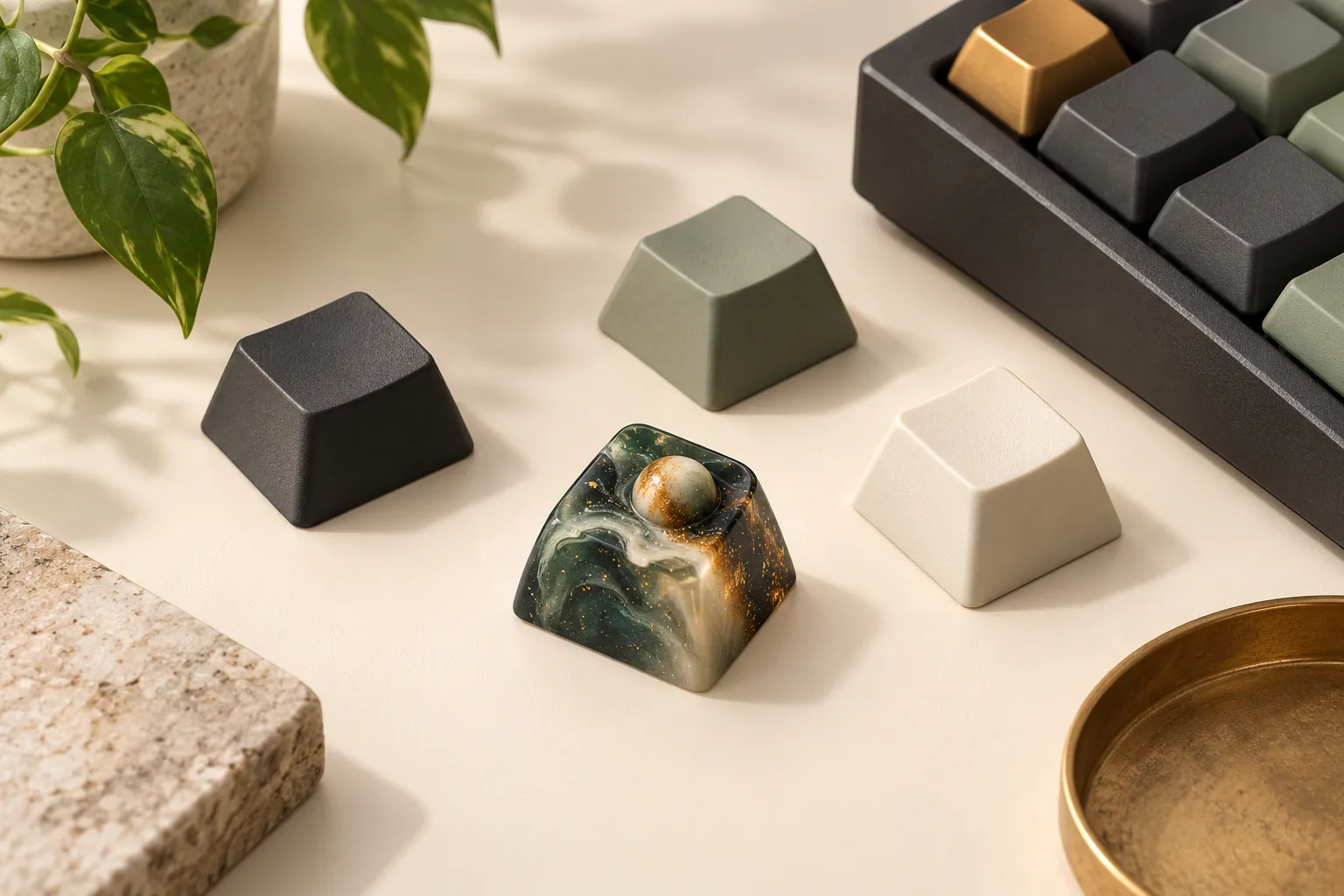
Artisan keycaps are decorative replacement keys made as small crafted objects. The examples here include cast resin and polymer clay sculpted onto a PBT base. Choosing one involves identifying the object, checking how it attaches to the switch, and confirming that its shape suits the intended position. Jelly Key and Claybies document these different approaches.
Begin with the product selector. Record the collection, color or scene, size option, and whether the selection is a keyboard keycap or a display object. This matters when several objects share one product page.
For example, Jelly Key’s Galaxy Thieves page separates 1u keycaps from x32 and x77 art toys. Its dimensions of 55.5 × 55.5 × 47.6 mm and 74 × 74 × 63.5 mm describe the larger art toys. Neither set provides the dimensions of the 1u keycap. The same page identifies the keycap’s stem as MX. Source: Galaxy Thieves.
For your comparison notes, treat 1u as the listing’s single-key size designation. Keep actual width, depth, total height, and any projecting details in separate fields. A size label should never become an invented measurement.
Compare documented artisan keycaps
These examples illustrate different selection paths. They are research leads and historical references, with no current US purchase offer established here.
| Example | Documented construction | Documented fit labels | What should drive your decision |
|---|---|---|---|
| Jelly Key Galaxy Thieves | Handmade resin casting and multilayer coloring; maker says it is not 3D printed | MX stem; separate 1u keycap option | Consider for its cast construction and TV-scene design; distinguish the cap from the art toys. The 2022 group buy is closed. |
| Claybies Sleeping Toto | Polymer clay sculpted onto an R4 PBT base, with acrylics, UV resin, and glass; maker describes no molds or 3D printing | MX-style (+) connection; maker suggests Escape or function-row placement | Consider if you want a clay sculpt and can follow its decorative-use and handling guidance. The base label does not establish finished sculpt height. |
| Keychron Galaxy Resin Artisan Keycap | Resin, according to the official product excerpt | Tall SA profile; 1u accent-key use | Consider as a galaxy-resin lead if a tall accent suits your plan; obtain exact dimensions and stem details before deciding. |
For galaxy resin keycaps, first decide which documented design approach you prefer. Jelly Key supplies a casting description for Galaxy Thieves; Keychron’s excerpt supplies material, profile, and intended size labels. That difference determines which questions remain unanswered, rather than proving one product performs better.
For a clay character sculpt, Sleeping Toto provides a more specific materials list and item-specific care instructions. Those details help you assess ownership requirements. They do not support a ranking for strength, typing feel, or sound across these examples.
Verify the maker and edition
Ask a seller for photographs of the actual piece: the top, sides, underside, and included identification or packaging. Match those records to the exact collection and variant on the maker’s page. A reused promotional image cannot answer questions about the particular item being sold.
Jelly Key’s support page describes an underside Jelly Key marking and a serial number that should match the included dog tag. The Galaxy Thieves listing also describes a serial on the keycap bottom and an engraved dog tag in the original package. For a secondhand example, request readable photographs of both numbers. Source: Galaxy Thieves package description.
Jelly Key says serial numbers have been included since around April 2017. If a seller presents an older piece, ask the maker which identification features apply to that edition. Treat matching records as useful verification evidence, without assuming they independently settle every authenticity question. Source: Jelly Key support.
Claybies describes a hand-painted paw signature on the underside of Sleeping Toto. That is a maker-specific feature to check against the seller’s photographs; it is not a universal artisan authentication mark. Its captured listing also describes a clear display gift box, so ask what packaging remains with a particular secondhand piece. Source: Sleeping Toto.
If photographs, edition names, or included records disagree, resolve the discrepancy with the maker before payment.
Build an accent-key fit card
Separate the connection question from the clearance question. Jelly Key identifies its current stem design as Cherry MX, and Claybies advertises an MX-style (+) connection for Sleeping Toto. Neither statement supplies every measurement needed to confirm a sculpt on your target board. Jelly Key support · Sleeping Toto.
Use this worksheet for each candidate. An unresolved field is a question to answer before choosing, rather than permission to assume compatibility.
| Field | What to record or request |
|---|---|
| Exact object | Maker, collection, edition, color or scene, and selected keycap size; exclude display-toy specifications. |
| Target setup | Your exact keyboard model, switch model, and intended key position. |
| Stem connection | The cap’s stated stem family and the maker’s confirmation for your exact switch. Keychron’s captured excerpt does not establish this field. |
| Footprint | The selected size label plus actual width, depth, and any sculpt overhang. |
| Finished height | Total sculpt height and how that measurement is taken. R4 base and tall SA labels do not supply an exact finished height here. |
| Clearance | Underside, neighboring-key, and case clearance through the intended key’s full travel. Request relevant dimensions or confirmation for the exact combination. |
| Orientation and legend | Which way the sculpt faces, whether any functional legend is present, and whether you need that label at your chosen position. |
| Supporting record | Maker documentation, dimensioned photographs, and any written fit confirmation for the selected variant. |
For a low-profile, optical, or magnetic keyboard, give the maker the exact switch name. Ask separately about attachment and physical clearance. An MX-looking connection or a broad compatibility statement should not replace that confirmation.
Worked example: a galaxy accent on Escape
Suppose you want Keychron’s Galaxy Resin Artisan Keycap for Escape. You can enter resin, tall SA profile, and 1u accent use from the official excerpt. Leave exact height, stem specification, and board clearance unresolved. Use the SA keycap shape and row checks to separate a profile label from documented dimensions.
Send the maker your keyboard and switch model, identify the Escape position, and request the missing dimensions and fit guidance. If those answers remain unavailable, keep the cap as a visual candidate. The worksheet has identified a promising design, but it has not yet established an installed fit.
Follow care instructions for the exact item
Sleeping Toto has specific handling guidance. Claybies recommends gentle use of a keycap puller or careful hands during placement and removal, while avoiding pressure on delicate details. For dust, it suggests a dry or damp cotton swab or a small paintbrush. It also advises avoiding alcohol, acetone, rough handling, and direct sunlight. Source: Sleeping Toto care instructions.
The maker describes this item as a decorative collectible and recommends Escape or function-row placement over commonly used keys. If you want an accent on a key you press repeatedly, discuss that intended use with the maker before choosing this sculpt. Source: Sleeping Toto placement guidance.
Keep those instructions attached to the Sleeping Toto entry in your notes. For a different resin or mixed-material cap, obtain its own maker-approved cleaning, removal, and storage instructions. The materials label alone does not establish an appropriate cleaning procedure.
Confirm the sale and seller terms
Galaxy Thieves is a useful historical construction and identification example. Its page explicitly says the 2022 group buy is closed, even though product selectors and an Add to Cart control appear on the page. Those controls do not establish a current accepted US order. Source: Galaxy Thieves.
Before paying any seller, get written answers to these questions:
- Exact contents: Which variant is supplied, and are the pictured packaging and identification records included?
- Order status: Is this a ready item, a preorder, a group buy, or a secondhand sale?
- Timing and delivery: What production estimate applies, what happens after dispatch, and can this exact order ship to your US address?
- Cancellation: What event ends your ability to cancel, and what happens if production is delayed?
- Defects: When does the reporting deadline start, what evidence is required, and who handles the remedy and shipping costs?
For a Jelly Key order, specifically clarify the defect-reporting clock. Its captured support wording ties reporting to purchase while also describing production lead times. Obtain an order-specific explanation of how the deadline applies to an item delivered later. Source: Jelly Key support.
Use the linked maker pages to identify products and ask questions. Current prices, stock, accepted US orders, and applicable seller terms remain to be confirmed.
Frequently asked questions
Does an MX stem guarantee that an artisan keycap fits?
An MX stem label establishes a connection claim, not complete clearance for a sculpt. Jelly Key and Claybies provide MX-related labels, but the information here does not confirm a particular installed combination. Check finished dimensions, underside space, neighboring keys, and the case for your exact board. Jelly Key support · Sleeping Toto.
Does a tall SA label tell me the exact height?
No. Keychron’s official Galaxy excerpt describes a tall SA profile and 1u accent use, without supplying an exact sculpt height. Use those labels to decide which dimensions to request. They do not resolve whether the selected cap clears the case and adjacent keys on your keyboard. Source: Keychron Galaxy.
What should I request when buying secondhand?
Request photographs of the actual cap, its underside, and included identification records. For Jelly Key, compare the keycap serial with the dog tag; for Sleeping Toto, check the maker-described paw signature. Confirm the edition and ask the maker about unresolved discrepancies before treating the seller’s description as verified. Jelly Key support · Sleeping Toto.
Make your choice
Choose artisan keycaps when the design you want also has a verifiable identity, a confirmed connection, sufficient physical clearance, and care requirements you can follow. Use the documented process to choose your aesthetic direction, then let the fit card determine whether that candidate is ready to buy.
Your next step is to send the completed card and any unresolved questions to the maker or seller before payment.