As an Amazon Associate we earn from qualifying purchases.
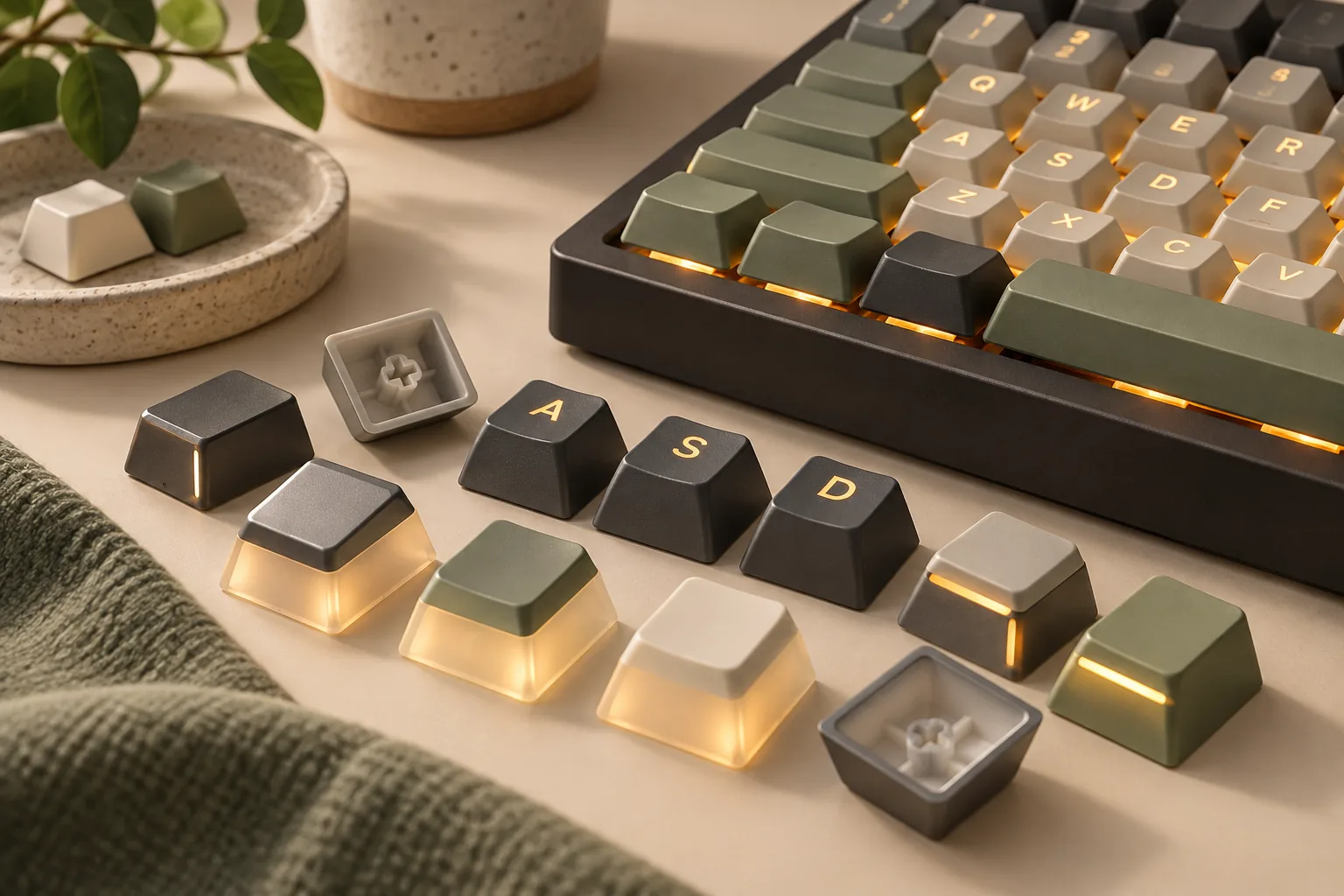
Choose backlit keycaps by deciding where you want visible light: through characters on top, through side legends, or through translucent pudding walls. Then check the exact set’s construction, LED guidance, and physical coverage. For owners upgrading a mechanical keyboard, the best choice is the design that makes the keys readable from their usual seat and supplies the caps their layout needs.
Quick takeaways
- Start with top legends if you want to read characters on the key surfaces.
- Consider side legends if you prefer characters on the sides; check them from your seated position.
- Consider pudding designs if illuminated walls are part of the appearance you want.
- Verify lighting and complete fit separately from the PBT or double-shot label.
This research-based guide uses manufacturer descriptions and a dated independent review. It contains no hands-on brightness, sound, or durability test results. Source information was recorded on October 15, 2026.
On this page: Lighting designs · PBT claims · Top legends · Side legends · Pudding designs · Selection worksheet · FAQs
Choose backlit keycaps by what lights up
Shine-through keycaps transmit keyboard lighting through designated areas, such as character legends or translucent walls. Top and side describe legend placement; pudding describes the wall design in the HyperX example below. These descriptions answer a different question from PBT and double-shot, which identify material and construction. The documented examples show why separating those fields helps.
| Lighting design | Documented example | Choose it when… | Important check |
|---|---|---|---|
| Top legends | Keychron Cherry-profile PBT-111, 121 keys, with top-center legends | You want characters on the top surfaces | Keychron warns of reduced shine-through with south-facing LEDs; Scroll Lock and Pause Break are omitted |
| Side legends | Keychron/Lemokey OSA set, 141 keys; black variant PBT-68 | You want illuminated characters on the sides | Check seated visibility; Menu, Scroll Lock, and Pause Break are omitted |
| Pudding walls and top legends | HyperX 104-key US set reviewed in 2020 | You want translucent lower walls as part of the lighting effect | Keep this historical set’s identity separate from later generations |
Sources: Keychron Cherry-profile set, Lemokey OSA specifications, Keychron OSA variant identity, and Techaeris’s May 26, 2020 HyperX review.
Treat the table as a shortlist by appearance and reading preference. It does not establish a brightness ranking. A design can match your preferred look while still failing the coverage check for your keyboard.
Check PBT and double-shot claims separately
PBT is the material label; CORSAIR spells it out as polybutylene terephthalate in its PRO keycap installation guide. Double-shot describes the production method. Neither label, by itself, identifies whether light passes through top legends, side legends, or walls.
The named examples make that distinction concrete. Keychron describes its Cherry-profile set as double-shot PBT with top-center legends. The Lemokey OSA set lists double-shot PBT and backlight shine-through legends, while HyperX describes Pudding keycaps as double-shot PBT with a translucent dual-layer design.
For any candidate, look for separate answers to these questions:
- Material and method: Does the manufacturer identify PBT and double-shot construction for the selected variant?
- Light transmission: Does it explicitly describe shine-through legends, translucent walls, or both?
- Legend placement: Are the characters on top or on the side?
- Physical coverage: Does the kit supply the correct profile, row positions, widths, stems, and stabilizer connections?
Do not infer sound, typing feel, or superior lighting from the construction label. The available evidence supports identifying these sets and their stated features, not ranking their acoustic or tactile performance.
Top legends: Keychron Cherry-profile PBT-111
Keychron’s Cherry Profile Double-Shot PBT Shine-Through Keycap Set provides a specific top-legend example: the black full set has 121 keys, SKU PBT-111, and top-center legends. It omits Scroll Lock and Pause Break, so check those positions before treating it as a complete replacement. These details belong to this Cherry-profile set.
Keychron also warns that this set’s shine-through effect may be reduced on keyboards with south-facing LEDs. That is a reason to check your keyboard’s documented LED orientation before choosing it. It does not establish that every top-legend set behaves identically, or that another LED orientation guarantees your preferred result. Use the south-facing LED keycap checks to separate illumination from physical clearance.
Choose this style if reading characters on the tops is your priority, subject to that product-specific warning. If you type with the lighting off during the day, include that condition in your sample check. Decide whether you can read the legends comfortably without relying on the illuminated product photos.
Side legends: Keychron and Lemokey OSA PBT-68
The matching OSA side-printed full set contains 141 keys; Keychron identifies the black variant as PBT-68. Lemokey’s manufacturer specifications list double-shot PBT, 1.6 mm thickness, MX-style stems, shine-through legends, and ANSI layout support. Its omissions are Menu, Scroll Lock, and Pause Break. See the Keychron variant listing and Lemokey specifications.
The manufacturer names supported ANSI keyboard families, including Q, Q Pro, Q Max, V, and V Max, with Q60 and Q60 Max explicitly excluded. Those exclusions matter even when a broad family name looks promising. For an unlisted board, confirm individual key coverage instead of assuming the stem specification settles compatibility. The manufacturer compatibility description is the starting point. The Keychron PBT set guide keeps the named products and exclusions separate.
Side legends deserve a viewing-position check before you commit. Sit at your normal desk height, use your usual keyboard angle, and inspect the characters you look for while typing. If evaluating a sample, check it with your hands in their normal position as well as moved away.
Keep the profile identities separate: this is the OSA set, while PBT-111 is Cherry profile. The OSA set’s thickness specification does not supply a height or thickness measurement for the Cherry set. Compare the selected kit’s row and profile diagram with your board rather than transferring specifications between them. For the OSA shape decision, compare the KSA and OSA shape comparison.
Pudding designs: the dated HyperX example
Pudding keycaps use a visibly translucent lower-wall design in the HyperX example documented here. HyperX’s manufacturer description identifies double-shot PBT and a translucent dual-layer design intended to expose keyboard lighting. That supports the design description, not a measured brightness advantage over the other sets.
The Techaeris review dated May 26, 2020 describes a 104-key US set, with translucent lower walls, opaque black or white tops, and illuminated top legends. Its part numbers are HKCPXP-WT-US/G and HKCPXP-BK-US/G. This illustrates that pudding walls and shine-through top legends can occur together.
Use that review to understand the appearance of that generation. Its key count and part numbers do not establish the geometry or coverage of a later Pudding2 set, including a 112-key pack. Match the actual product name, generation, and kit diagram before applying any compatibility statement.
The same review lists an included puller and layout guide, and reports that an incompletely engaged removal tool can slip and mark the translucent portion. That is the reviewer’s handling observation, not a universal durability finding. Follow the installation guidance for your selected set and keyboard rather than assuming an included tool guarantees damage-free removal.
Use this lighting-and-fit worksheet
Use the following worksheet to evaluate a candidate. The lighting checks are prospective: perform them yourself if a suitable sample is available. Record observations in your own words rather than treating the examples above as test results.
| Check | What to inspect or record | Decision rule |
|---|---|---|
| Exact identity | Product name, SKU, color, generation, and kit count | Resolve any mismatch between the selected option and its specifications |
| Room light, LEDs off | Read letters, numbers, and symbols you regularly need | Keep the candidate only if unlit readability meets your needs |
| LEDs on | Inspect legends and walls separately at your normal setting | Judge the light-transmitting area you actually care about |
| Seated view | Use your usual chair height, board angle, and hand position | Confirm that the legend placement works from that position |
| Complete layout | Match every required key to the kit diagram | Resolve missing legends or positions before ordering |
| Physical fit | Check stem, profile row, width, and stabilizer connections | Obtain exact coverage information for uncertain keys |
For the fit check, compare your keyboard’s layout with the selected kit key by key. Pay particular attention to the spacebar, Shift, Enter, Backspace, and bottom-row modifiers. Confirm both the physical cap and the legend you want; a large total key count does not answer those questions by itself.
CORSAIR’s PRO mod-kit guide shows why compatibility wording needs context. It lists supported CORSAIR models and describes broader compatibility in terms of a standard bottom row with MX-style keyswitches and stabilizers. The guide supplies installation steps and an included puller, but it is not a complete per-key geometry chart for every board or later kit revision.
Worked example: south-facing LEDs and a required Scroll Lock key
Suppose your board has south-facing LEDs and you want a matching Scroll Lock cap. PBT-111 raises two checks: Keychron’s LED warning and the omitted Scroll Lock cap. The OSA set changes the legend placement, but it also omits Scroll Lock. Neither documented kit settles your requirements without a plan for that key. Sources: Cherry set and OSA set.
A practical next step is to decide whether retaining your existing cap is acceptable. If you require a fully matching set, seek another kit with explicit coverage. Then evaluate its lighting separately; changing the shortlist should not turn an unresolved fit question into an assumed lighting improvement.
Before checkout, verify the seller’s exact variant, delivered price, stock, and return terms, including whether installed keycaps can be returned. Those commercial details are not established by the product examples in this guide.
Frequently asked questions
What are the best shine-through keycaps for south-facing LEDs?
There is no measured winner established here. Keychron warns that south-facing LEDs may reduce shine-through on its PBT-111 top-center-legend set. Use that warning to screen this specific candidate, then evaluate alternatives for seated readability, lighting, and complete coverage. Source: Keychron’s Cherry-profile description.
Does “side-printed” mean the legends shine through?
Check the exact product’s legend specification. For the OSA set discussed here, Lemokey explicitly lists backlight shine-through legends alongside side placement, double-shot PBT, and MX-style stems. Use that documented combination as evidence for this set; ask for the same separate fields when considering another product. Source: Lemokey specifications.
Are MX-style stems enough to confirm compatibility?
Use the stem specification as one check, then verify the complete layout. CORSAIR’s PRO guide also references a standard bottom row and stabilizers, while the OSA set has named exclusions and omitted legends. For an unlisted board, compare widths, row positions, and stabilizer connections. Sources: CORSAIR and Lemokey.
Make your choice
Choose backlit keycaps in this order: preferred light-transmitting area, readability on your board, and complete physical coverage. Top legends, side legends, and pudding walls offer different selection paths; PBT and double-shot labels help identify construction. Open the exact candidate’s official specifications and work through the worksheet before ordering.