As an Amazon Associate we earn from qualifying purchases.
Choose KSA or OSA keycaps by checking the exact set’s layout coverage and legend lighting first, then investigating its shape. Among the three sets compared here, Keychron’s side-printed OSA is the option with documented shine-through legends; the cited KSA and ordinary Lemokey OSA sets have non-shine-through legends. Their specifications belong to those individual products. Keychron KSA, Lemokey OSA, Keychron side-printed OSA.
This guide is for owners comparing replacement keycaps for an existing keyboard. It covers those three named sets, their documented construction, shape evidence, and the checks needed before ordering.
Quick takeaways
- Want illuminated legends? Start with the side-printed OSA set and verify your exact keyboard and lighting arrangement.
- Interested in shape? Historical samples suggest different directions to explore, but they do not establish current dimensions for every set.
- Need complete coverage? Check individual keys and exclusions before choosing a profile.
This is a research-based comparison using manufacturer product excerpts captured October 15, 2026, plus attributed independent descriptions. It includes no hands-on testing or original measurements.
On this page: Product comparison · Shape · Construction and lighting · Layout coverage · Fit worksheet · Buying options · FAQ
KSA and OSA keycaps: three documented sets
The useful comparison starts with full product identities. These manufacturer specifications show why “OSA PBT keycaps” alone does not tell you the thickness or whether the legends—the characters on the caps—transmit backlight.
| Specification | Keychron KSA full set | Lemokey ordinary OSA full set | Keychron side-printed OSA full set |
|---|---|---|---|
| Material and molding | Doubleshot PBT | Doubleshot PBT | Doubleshot PBT |
| Nominal thickness | 1.6 mm | 1.3 mm | 1.6 mm |
| Stem interface | MX style | MX style | MX style |
| Legend lighting | Non-shine-through | Non-shine-through | Shine-through |
| Listed layout | ANSI | ANSI | ANSI |
| Manufacturer source | KSA specifications | Ordinary OSA specifications | Side-printed OSA specifications |
Thickness is separate from overall keycap height. The 1.3 mm and 1.6 mm specifications do not describe how far each row’s typing surface sits above the switch. They cannot establish a numerical height difference between KSA and OSA.
All three share the listed material, molding method, and stem category. The documented differences that immediately affect selection are thickness, legend lighting, and the coverage attached to each product. None of those fields establishes a sound, speed, or comfort winner.
Shape: what the evidence establishes
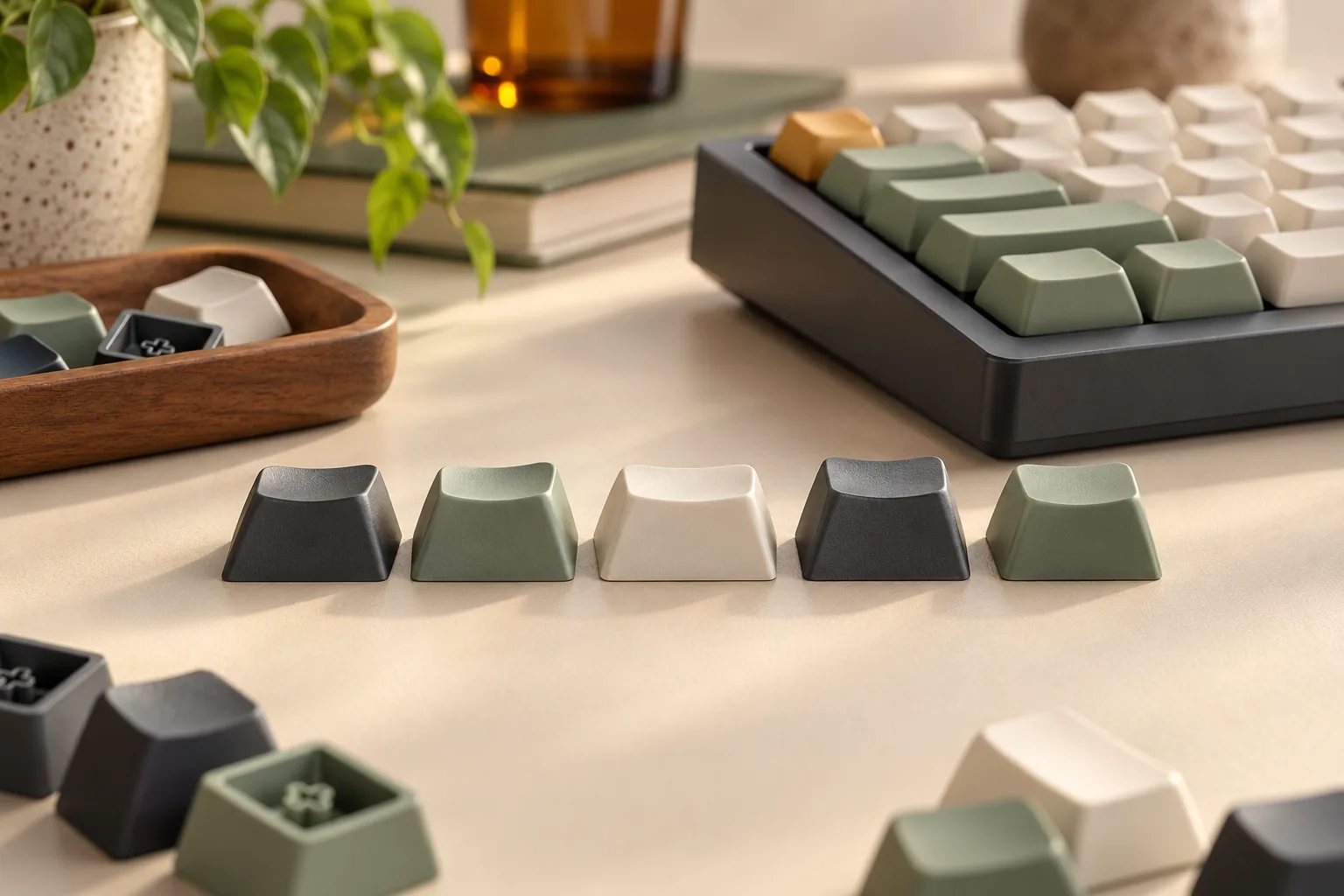
A keycap profile describes keycap shape across keyboard rows. Keychron identifies its KSA product as a redesigned SA profile, giving it a manufacturer-stated design identity without supplying readable row measurements in the retained excerpt. The Keeblog’s profile overview and Keychron’s KSA specification provide that context.
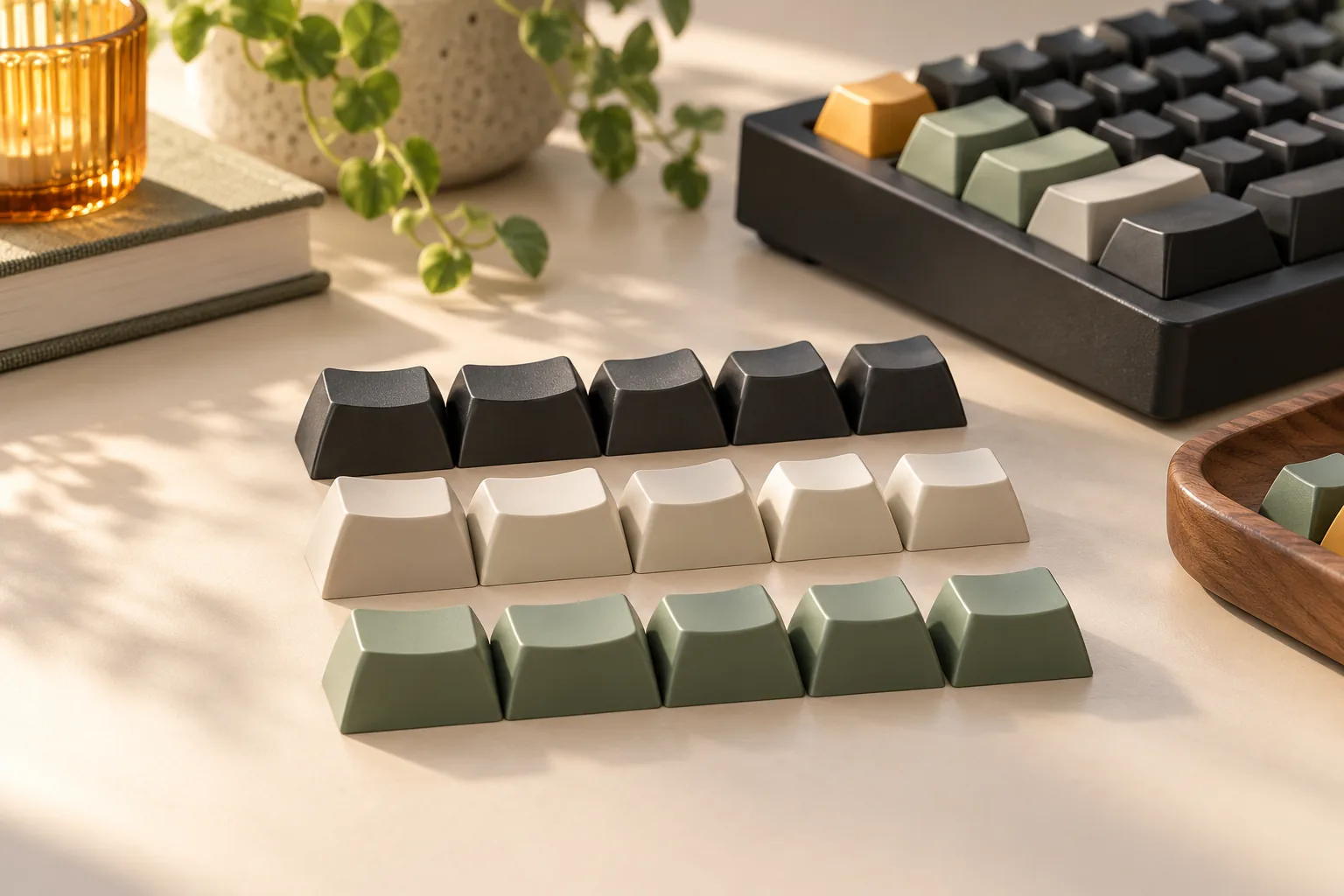
In a June 29, 2023 comparison, Pacific Debates described the sampled OSA caps as OEM-height and cylindrical, and the sampled KSA caps as tall, angled, and dish-like. The author warned that individual sets could vary and explicitly left kit coverage out of the comparison. Those observations help identify shapes to investigate; they are historical sample impressions rather than specifications for the three current product listings. Read the sample comparison.
There is also a reason to treat general profile diagrams carefully. The Keeblog records a December 31, 2024 correction changing its OSA wording from spherical to cylindrical. It labels its KSA/OSA comparison drawing an artist’s interpretation. That drawing cannot settle exact row heights, angles, or top-surface radii. See the correction and drawing context.
For your own choice, request photographs or dimensioned drawings of the exact sets from the same reference position. Compare corresponding rows on a common baseline, then look at the typing surface from above and from the side. If samples are available, use them to judge the shape you prefer before committing to a full set.
KSA is a candidate to investigate if the taller, dish-like historical description appeals to you. Ordinary OSA is a candidate if the historical OEM-height, cylindrical description sounds closer to your preference. Neither description guarantees how the exact selected package will feel. For an SA-family alternative, compare the SA keycap guide using that set’s own documentation.
Construction and lighting: which differences matter?
For these products, selecting doubleshot PBT does not settle the lighting question. Ordinary Lemokey OSA has a listed 1.3 mm thickness and non-shine-through legends; Keychron’s side-printed OSA has a listed 1.6 mm thickness and shine-through legends. The KSA full set also lists 1.6 mm thickness, with non-shine-through legends. Ordinary OSA, side-printed OSA, KSA.
If illuminated characters are a requirement, investigate the side-printed OSA option first. Ask for a photograph showing that exact variant on your keyboard model or an equivalent lighting arrangement. The shine-through specification establishes the legend feature, but the retained evidence does not establish brightness or visibility on every board. Use the LED orientation and keycap checks to keep the lighting and clearance questions distinct.
Keep attachment and full fit as separate checks, too. All three manufacturers’ entries say “MX style.” For an unlisted keyboard, including a low-profile model, verify the exact switch, keycap clearance, and kit inventory before extending compatibility beyond the named hosts.
Layout coverage: check the exact keyboard
The compatibility lists below summarize documented coverage and selected named hosts. Use the linked product entry to investigate your exact model; a shared family name or layout percentage is not enough to resolve every key position.
| Set | Documented coverage to investigate | Explicit boundary |
|---|---|---|
| Keychron KSA | ANSI; named Q HE models, eligible Q and V family boards, 81 Pro, and Lemokey L1, L3, L4, P1, P1 Pro, and P1 HE, among other listed hosts | Cited Q-series coverage excludes Alice-layout keyboards, split-layout keyboards, and Q9 Plus; cited V-family coverage excludes Alice layouts |
| Lemokey ordinary OSA | ANSI Lemokey L1, L3, L4, P1, P1 Pro, and P1 HE | Macro, Menu, Scroll Lock, and Pause Break caps are not included |
| Keychron side-printed OSA | ANSI Q/Q Max, Q Pro, Q Ultra, Q HE, and named V, K, C, and Lemokey hosts | Q/Q Max coverage explicitly excludes Q60 and Q60 Max |
Manufacturer-listed coverage and complete legend coverage answer different questions. For example, Lemokey lists the ordinary OSA set for the ANSI L3 while also stating that macro caps are omitted. If matching macro labels are part of your goal, include that omission in your decision. Lemokey’s compatibility and contents notes. The Keychron PBT product guide provides another way to compare the named sets and their omissions.
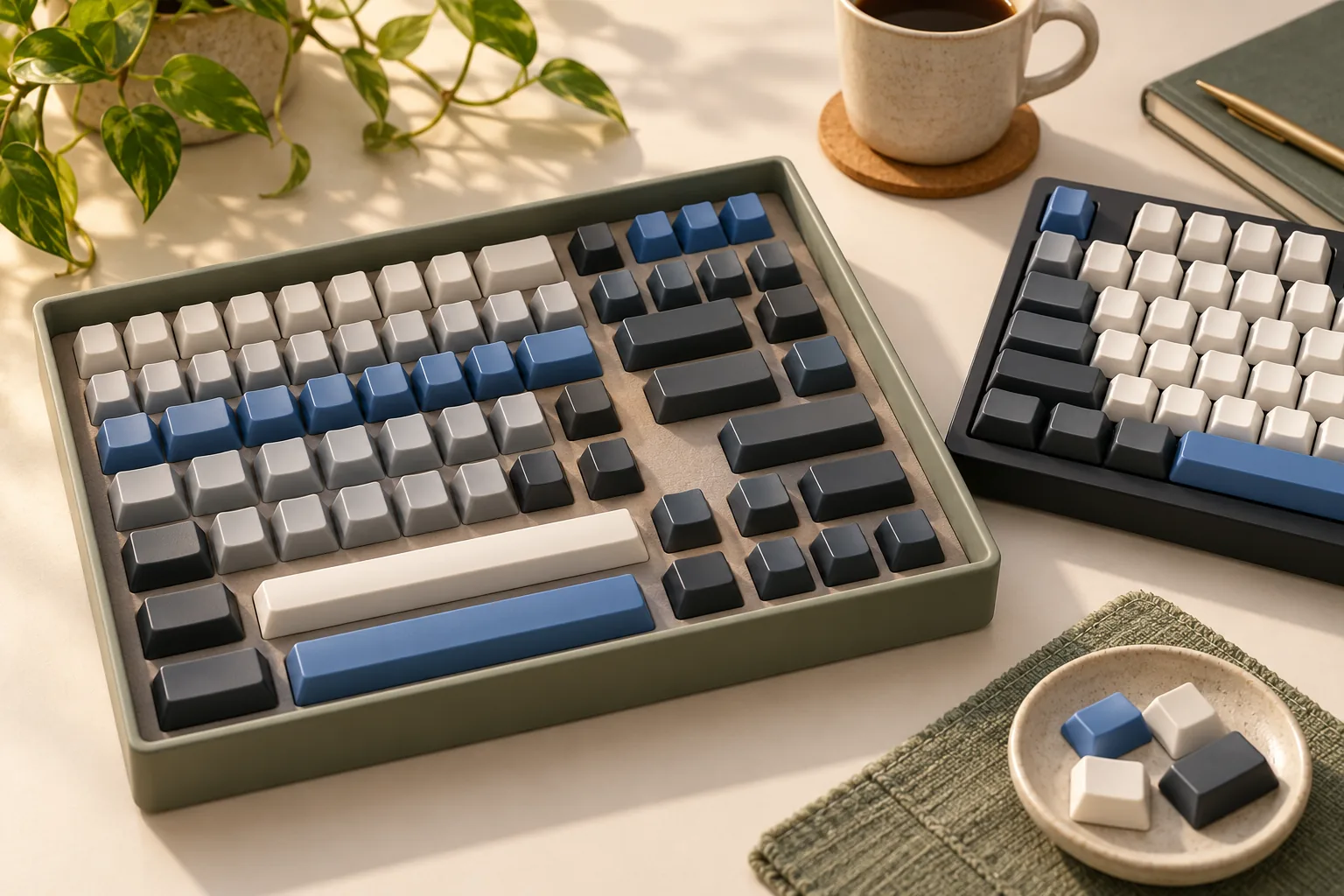
For a keyboard outside the named coverage, compare its layout diagram with the selected kit’s inventory. Verify the required widths, row assignments, spacebar, and stabilized positions. Leave ISO, JIS, Alice, split, or other undocumented coverage unresolved until the exact package is confirmed.
A practical fit worksheet
Use this worksheet for each candidate set. Record a specific answer or mark the item unresolved; the goal is to identify what needs confirmation before checkout.
| Check | What to record | What resolves the question |
|---|---|---|
| Keyboard identity | Exact model, revision, and layout | A matching manufacturer compatibility entry or specific seller confirmation |
| Attachment | Exact switch and required stem interface | Documentation for the actual keyboard and selected caps |
| Key widths | Every required modifier, Enter, and spacebar width | A complete kit diagram matching each position |
| Row placement | Required row for each replacement key | A kit inventory showing the needed cap in that row |
| Stabilized positions | Spacebar and other stabilized keys | Confirmation of the required sizes and mounting arrangement |
| Legends | Every label you want, including macro and navigation keys | An inventory that includes those exact labels |
| Clearance | Any fit concern around switches or the case | Applicable drawings, samples, or confirmation for that combination |
This is a checking method, not a claim that the three sets contain every item in the worksheet. The retained manufacturer excerpts do not provide complete readable per-key width and row inventories. Start with the KSA, ordinary OSA, or side-printed OSA product information, then resolve any remaining positions.
Two examples of how the checks change a choice
ANSI Lemokey L3 with matching macro labels required: ordinary OSA has a listed host match, but its macro-cap omission leaves the labeling requirement unmet. Before ordering, determine whether you will retain existing caps, accept different labels, or choose another specifically documented package. Do not assume the words “full set” resolve that requirement. Lemokey OSA contents.
Q60 Max with shine-through legends required: the side-printed OSA set has the relevant lighting specification, but its Q/Q Max list excludes Q60 Max. Remove that set from this purchase shortlist unless new, exact compatibility evidence resolves the exclusion. Its lighting feature does not override the stated boundary. Keychron side-printed OSA coverage.
Buying options: verify the selected package
The three official product links above are starting points for checking the named sets. Current price, stock, US delivery, color-specific contents, and applicable returns have not been verified for this comparison.
Before paying, check:
- Full product name: distinguish KSA, ordinary OSA, and side-printed OSA.
- Selected package: confirm the color, layout, and kit option currently selected.
- Included caps: obtain a readable inventory and resolve every worksheet item that matters to your board.
- Lighting: confirm the selected variant’s legend specification and suitability for your setup.
- Seller terms: check delivery destination, total checkout cost, and return conditions, including any restrictions after installation.
If a listing presents several related products, match the specifications to the selected item before using them. A neighboring recommendation or add-on is not confirmation that its construction or coverage applies to your package.
When contacting a seller, make the question specific: “Does this exact color and kit include the required key in the correct width and row for my keyboard model?” Attach the keyboard’s layout diagram if needed. A clear answer is more useful than a general statement that a set fits a particular percentage layout.
Frequently asked questions
Are OSA keycaps spherical or cylindrical?
Pacific Debates described its 2023 OSA sample as cylindrical, and The Keeblog corrected its OSA wording to cylindrical on December 31, 2024. Those sources do not establish a universal geometry for every OSA-branded product. Check the exact set’s drawings or samples when surface shape will determine your purchase. Sample comparison, correction.
Are ordinary OSA and side-printed OSA the same specification?
The cited products differ in documented thickness and lighting. Lemokey’s ordinary OSA lists 1.3 mm thickness and non-shine-through legends; Keychron’s side-printed OSA lists 1.6 mm thickness and shine-through legends. Treat them as separate buying options, each with its own compatibility and contents checks. Ordinary OSA, side-printed OSA.
How much taller is KSA than OSA?
The retained evidence does not establish an exact numerical difference for these products. Pacific Debates described its historical KSA sample as tall and its OSA sample as OEM-height. To establish current dimensions, request corresponding-row measurements from a shared baseline; the listed plastic thicknesses cannot answer that question. Historical sample descriptions.
Choose the set that meets your requirements
For these KSA and OSA keycaps, narrow the choice by exact layout coverage, included legends, and lighting. Side-printed OSA is the documented shine-through candidate; ordinary OSA and KSA remain options when illuminated legends are unnecessary and their selected kits meet your needs. Use the attributed shape descriptions to guide further inspection, then complete the fit worksheet against the exact package before ordering. KSA, ordinary OSA, side-printed OSA.