As an Amazon Associate we earn from qualifying purchases.
Favor PBT when retaining surface texture is your priority; choose ABS when a particular set's finish, shape, and design better match your preferences. In either case, verify its legends, layout coverage, and complete cost. Corsair favors PBT for wear resistance, but its comparison provides no controlled wear protocol or dependable lifespan estimate.
This guide is for buyers choosing replacement keycaps. It draws on manufacturer documentation captured October 15, 2026, and provides research-based selection advice.
Key takeaways
- Both ABS and PBT have documented double-shot options.
- Check the actual surface finish: textured ABS exists.
- Evaluate surface shine and legend construction separately.
- Equal stated thickness does not establish equal geometry or sound.
- Compare the cost of every required kit after confirming coverage.
On this page: Construction · Wear and texture · Legends · Sound · Fit · Inspection · Value worksheet · FAQs
ABS vs PBT Keycaps: Material and Construction
ABS means acrylonitrile butadiene styrene; PBT means polybutylene terephthalate. These names identify the plastic. Double-shot describes a molding process used for keycaps and their legends—the letters or symbols identifying keys. A useful comparison separates the plastic from the legend process, surface finish, thickness, and shape. Sources: Corsair's definitions and GMK's construction description.
GMK provides a useful counterexample to the assumption that double-shot construction belongs to one material. Its CYL family uses ABS, while MTNU uses PBT. Both list a thickness of 1.5 mm, although their profiles differ.
| Documented feature | GMK CYL | GMK MTNU |
|---|---|---|
| Material | ABS | Manufacturer specifies 100% PBT |
| Main construction | Double-shot | Double-shot |
| Stated thickness | 1.5 mm | 1.5 mm |
| Profile | Cylindrical Cherry profile with differing row heights and angles | Medium-height spherical shapes with curved edges |
| Surface description | Deliberate texture created by an erosion structure | No equivalent surface-texture detail in the cited description |
| Advertised mount | MX-cross | MX-cross |
| Additional labeling | Optional UV printing is available | Check the selected set's markings separately |
Sources: GMK CYL specifications and GMK MTNU specifications, captured October 15, 2026. These are family specifications; selected-kit inventories still require checking.
The practical lesson is to compare complete specifications. An ABS label does not establish the legend method or starting texture, and a PBT label does not establish the profile you will receive.
Wear and Texture: Check the Actual Finish
Corsair's material guide favors PBT for slower wear and longer texture retention. Its exact Mint Green PBT kit also advertises a textured surface that resists wear and shine. These are manufacturer descriptions, with no matched ABS-versus-PBT wear experiment supplied in the cited pages. Sources: Corsair material comparison and Mint Green kit.
That makes PBT a reasonable material to investigate if retaining texture matters to you. It does not establish how many months a particular set will stay unchanged, or how much longer it will last than an ABS alternative. Avoid paying a premium based on an unsupported lifetime multiplier.
Starting texture deserves its own check. GMK describes a deliberately textured surface on its ABS CYL caps. You therefore cannot reliably sort every ABS set into a smooth category and every PBT set into a rough category.
For each candidate, ask:
- What finish does the manufacturer describe for this exact set?
- Do available close-up images show the surface clearly?
- Does any wear claim include a test method or only descriptive language?
- Would visible polishing bother you if the legends remained readable?
The final question separates appearance from readability, which requires a different construction check.
Legends and Backlighting: Check Each Type of Marking
Surface shine and legend loss are separate buying questions. Corsair's guide connects ABS wear with both shine and loss of lettering, but that generalization does not account for every legend method. GMK documents double-shot ABS CYL keycaps and separately offers optional UV-printed labeling. A material label alone cannot tell you how every marking was made. Sources: Corsair's comparison and GMK CYL labeling options.
Check the main letters, secondary symbols, and decorative keys individually. If the main legends are double-shot, ask whether added artwork or secondary labels use the same process. Do not extend the main legend specification to an optional printed design without confirmation.
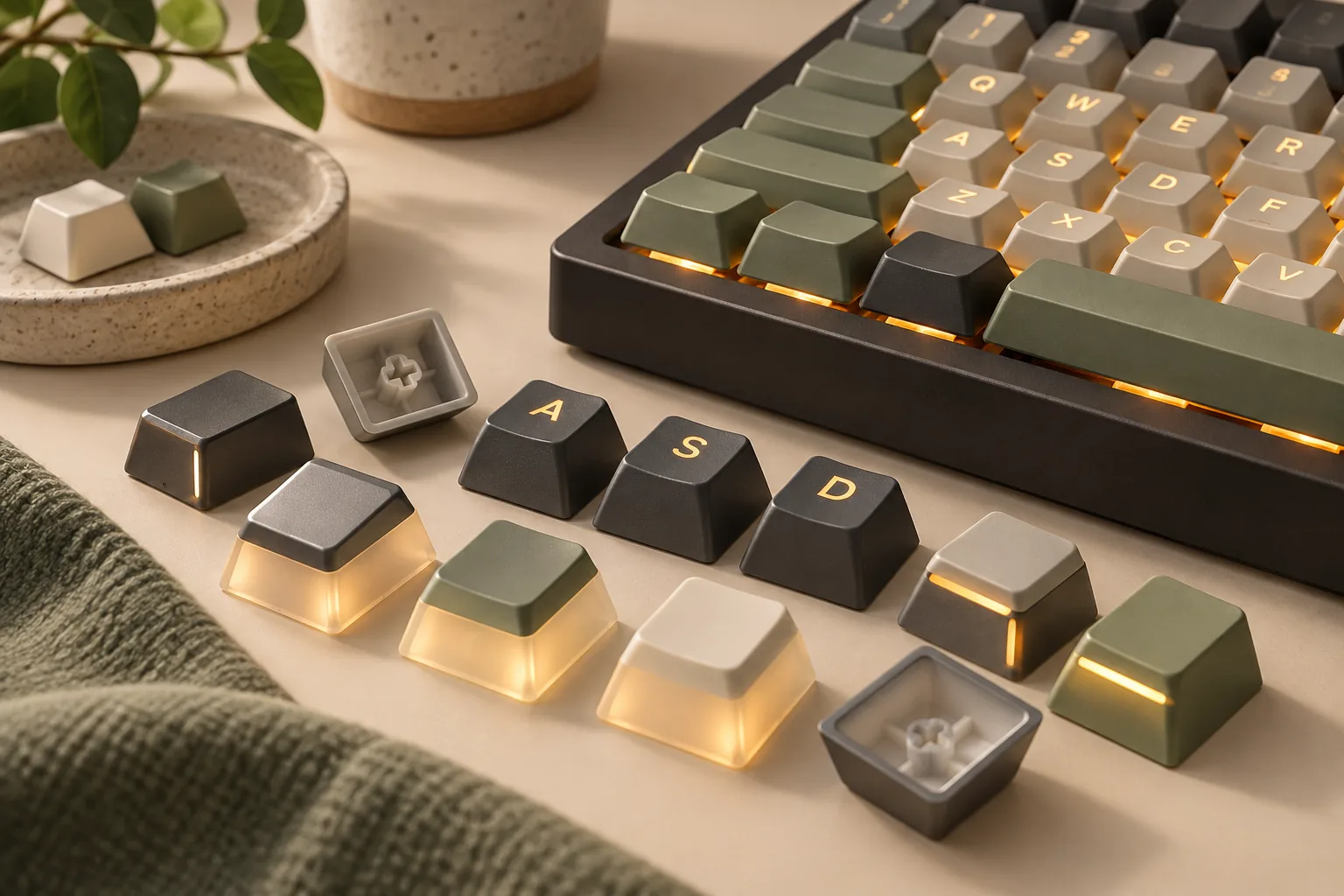
Backlighting needs another explicit check. Corsair's Mint Green NA kit, SKU CH-9911080-NA, is described as double-shot PBT with backlit legends. That supports a product-level lighting description for this kit; it does not establish the transmission or brightness of every optional marking, or the result on your keyboard.
If illuminated labels matter, make documented backlit legends a selection requirement. Ask for clarification about any secondary symbols you need to read in the dark.
Thickness, Profile, and Sound
The GMK examples show why thickness alone cannot settle a material comparison. CYL and MTNU both list 1.5 mm, but CYL uses a cylindrical Cherry profile and MTNU uses medium-height spherical geometry. Comparing those families changes material and shape together. Sources: GMK CYL and GMK MTNU.
These specifications establish neither a material-only acoustic result nor a universal sound winner. They also give no basis for declaring one profile more comfortable for every buyer.
If you compare recordings or try sets yourself, keep the keyboard, switches, profile, thickness, recording setup, and added dampeners as consistent as possible. Record any differences that remain. Treat the result as a comparison of the actual configurations when those conditions cannot be matched. The guide to keycap sound comparisons provides a worksheet for keeping those conditions consistent.
Choose a profile because its documented geometry suits your preference. Keep any sound expectation conditional on the full setup.
Layout Coverage: Verify the Whole Set
Both GMK families advertise MX-cross mounts. Their family pages also describe several kit categories and broad layout coverage. Those statements do not provide the complete row, width, spacebar, and stabilizer inventory of a particular selected kit. Sources: GMK CYL and GMK MTNU.
Corsair's exact kit illustrates another limit. Its page lists 104 PBT double-shot keycaps, 120 O-ring dampeners, a keycap puller, a quick-start guide, and a warranty card. Its compatibility statement for Corsair mechanical and optical-mechanical keyboards includes a standard-bottom-row condition. This does not establish compatibility with every optical switch or every keyboard layout. Source: CH-9911080-NA product page.
Use the following worksheet with your keyboard's layout information and the selected set's kit diagram.
| Check | Record for the keyboard and candidate kit | Decision rule |
|---|---|---|
| Stem mount | Exact switch stem and advertised keycap mount | Resolve any mismatch or ambiguity |
| Profile and row | Required position and supplied row shape for each key | Confirm the correct key exists in the required row |
| Key width | Required and supplied widths using the diagram's unit notation | Match each position individually |
| Bottom row | Spacebar and neighboring modifier arrangement | Check the full arrangement |
| Stabilized keys | Spacebar and other long-key dimensions and mount spacing | Obtain confirmation where diagrams omit details |
| Legends | Language, secondary symbols, and required illumination | Confirm the markings you actually need |
| Kit coverage | Base kit plus every necessary add-on | List the complete purchase before comparing cost |
A headline key count cannot answer all these questions. If one required key remains unresolved, keep that candidate provisional until the seller or manufacturer confirms it.
Warping and Consistency: Inspect the Actual Set
The cited documentation does not provide a controlled comparison of warping or manufacturing variation between matched ABS and PBT sets. There is no supported basis here for guaranteeing that either material will always arrive straight or consistent.
Treat these as inspection questions for the actual set. Check long keys for visible curvature, inspect markings for consistency, and compare the delivered contents with the kit diagram. Once compatibility is confirmed, check that the required keys install and move as expected.
If you find a problem, document the affected keys and contact the seller or manufacturer. Check the applicable return and support terms before ordering, especially when replacing a difficult-to-match spacebar or modifier.
Value: Compare the Complete Required-Kit Cost
Neither material has an established price advantage across the documented options. A useful value comparison needs current quotes for complete, suitable sets. It should also account for the extras necessary to obtain your layout and legends.
Copy this worksheet and fill the empty cells with quotes for your selected ABS and PBT candidates. Leave unresolved costs visibly unresolved until you have the information.
| Cost item | Selected ABS set | Selected PBT set |
|---|---|---|
| Exact set, variant, and seller | ||
| Base kit | ||
| Required layout or language add-ons | ||
| Required spacebar or modifier extras | ||
| Other necessary items absent from the package | ||
| Shipping | ||
| Tax or other applicable checkout charges | ||
| Complete checkout total | ||
| Quote date and applicable return terms |
Complete cost = base kit + required extras + necessary missing items + shipping + applicable charges. Count each expense once. Keep optional decorative additions separate so they do not obscure the cost of obtaining a usable set.
For example, suppose an ABS base kit appears less expensive, but its diagram leaves a required modifier unresolved. A PBT candidate documents that modifier in its base kit. The ABS option needs a coverage answer and, if necessary, an add-on quote before the two totals are comparable.
Package contents also matter. Corsair lists a puller and O-ring dampeners with CH-9911080-NA, so record those inclusions rather than assuming you must purchase them separately. Their presence does not determine whether you need or want to use them. Source: Corsair package contents.
Frequently Asked Questions
Are PBT keycaps always better than ABS?
No universal winner follows from these specifications. Corsair favors PBT for wear resistance, while GMK documents textured, double-shot ABS CYL caps. Choose a particular set by its finish, legend process, geometry, verified coverage, and complete cost. Those checks support a more useful decision than the plastic name alone. Sources: Corsair, GMK CYL.
Do double-shot keycaps have to be ABS?
No. GMK specifies double-shot ABS for CYL and double-shot PBT for MTNU, both at 1.5 mm thickness. Material and legend construction are separate specifications. Check additional artwork and secondary markings independently, particularly when a manufacturer offers optional printed labeling. Sources: GMK CYL, GMK MTNU.
Will a 104-key set cover my keyboard?
The count alone cannot establish coverage. Corsair's 104-key example has a standard-bottom-row condition for its stated Corsair compatibility, and the captured page does not supply a complete row-by-width inventory. Match your actual layout, mount, key widths, row shapes, and stabilizer geometry against the selected kit. Source: Corsair kit.
Which Should You Choose?
For ABS vs PBT keycaps, start with your priority: investigate documented PBT options for texture retention, or choose an ABS set whose finish and profile you prefer. Then require the same essentials from either candidate: suitable legends, confirmed layout coverage, and an acceptable complete cost.
Your next step is to complete the coverage worksheet for your two preferred sets before comparing their checkout totals.
Sources and dates: GMK CYL, GMK MTNU, and Corsair CH-9911080-NA: documentation captured October 15, 2026. Corsair's ABS/PBT comparison: last updated November 21, 2025; captured October 15, 2026.