As an Amazon Associate we earn from qualifying purchases.
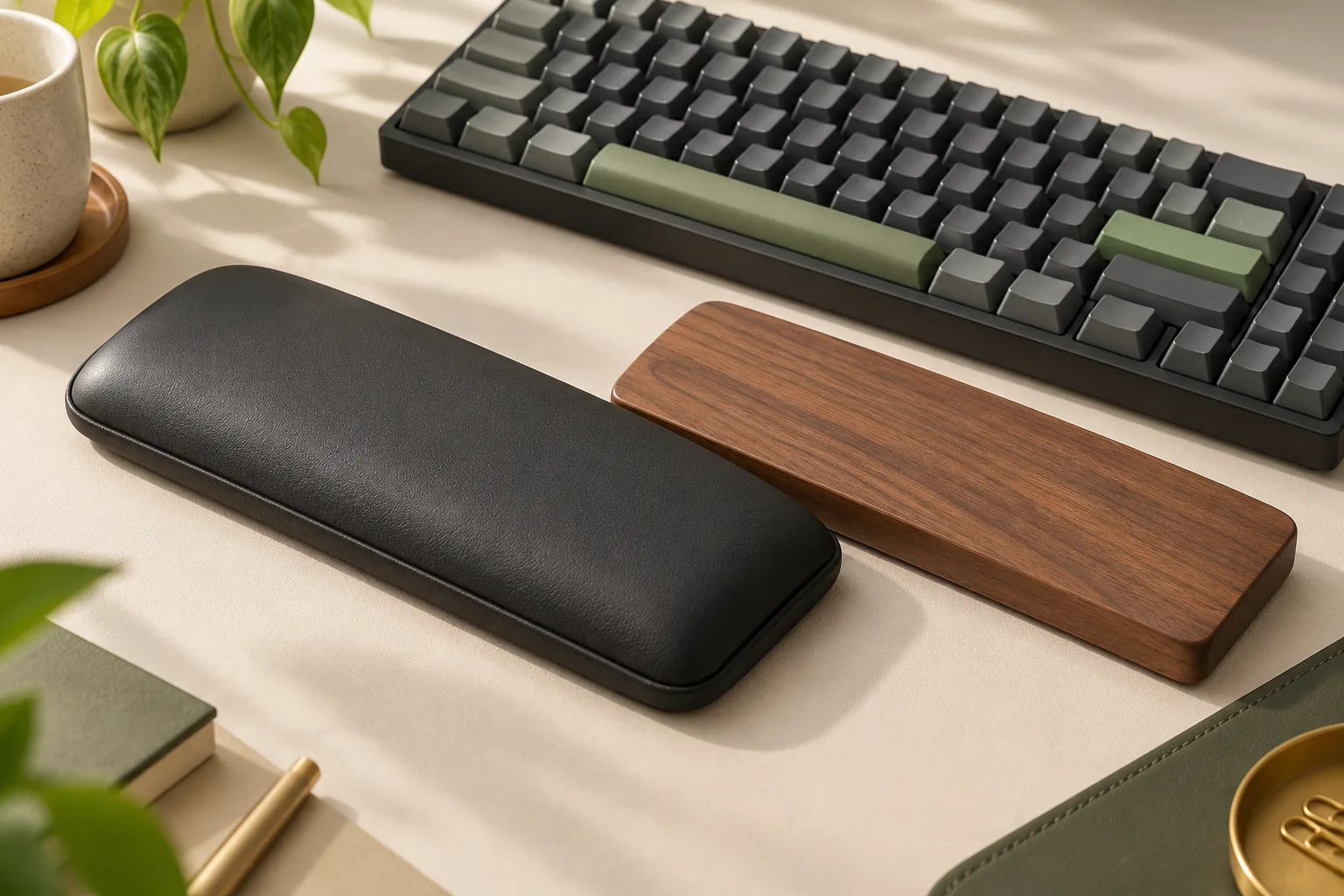
Choose a memory foam keyboard wrist rest if you want a padded construction; consider wood if you prefer an unpadded solid surface. For leather or leather-like options, verify the cover separately from the filling: Razer’s ordinary Ergonomic Wrist Rest combines memory foam with leatherette. These are construction choices, with examples documented by Glorious and Razer.
This guide is for keyboard users choosing among cushioning, solid wood, surface appearance, and manageable care. It compares documented constructions and gives you practical checks for shape, positioning, and maintenance. Comfort remains a personal judgment; the available evidence does not establish a universal material winner.
Quick takeaways
- Compare the core, cover, finish, and base separately.
- Choose a surface whose exact cleaning instructions suit your routine.
- Treat white as an appearance and care requirement.
- Check keyboard-front geometry and hand movement before committing to a material.
On this page: Construction comparison · Foam · Wood · Leatherette · White finishes · Decision worksheet · FAQs · Your next step
Evidence and method: This guide draws on official manufacturer and Canadian Centre for Occupational Health and Safety search excerpts retrieved October 15, 2026. Recommendations compare documented construction, care, and workstation guidance. No hands-on comfort, wear, or stain testing was performed.
Read the core, cover, finish, and base separately
A useful comparison separates four parts: the core is the material inside, the cover is the contact surface, the finish is any stated surface treatment, and the base is the underside or attachment arrangement. Record each part separately so a familiar material label does not stand in for the complete construction.
The distinction matters in the examples below. Glorious describes foam under cloth, while Razer describes memory foam under leatherette and a separate Pro construction under fabric. A foam core therefore does not tell you which surface you will touch or how to maintain it. See the Glorious material descriptions and Razer’s variant descriptions.
| Documented construction | What the manufacturer identifies | Care information available | Selection question |
|---|---|---|---|
| Glorious cloth wrist rest | Foam core with a cloth surface | The supplied excerpt does not establish a cloth-cleaning method | Do you want padded cloth, and can you obtain its exact care instructions? |
| Glorious wooden wrist rest | Solid USA-sourced hardwood with rubber feet | Glorious describes the wood option as suitable for a quick wipe-down | Do you prefer solid wood and accept the specific contour and finish? |
| Ordinary Razer Ergonomic Wrist Rest | Memory foam with a leatherette cover and rubber feet | Gentle surface wiping with a clean damp cloth; avoid harsh chemicals | Do you want this padded, leather-like surface? |
| Razer Ergonomic Wrist Rest Pro | Cooling-gel-infused memory foam with heat-transfer fabric | Consult the instructions for the selected variant | Are you deliberately choosing the Pro construction? |
Sources: Glorious cloth and material comparison, Glorious wood specifications, and Razer construction and care information. The table reports construction and care descriptions, not measured comfort or cooling performance.
Choosing a memory foam keyboard wrist rest
Start with whether you want cushioning, then choose the cover. Razer identifies memory foam in its ordinary Ergonomic Wrist Rest; Glorious identifies a foam core in its cloth model without establishing that it is memory foam in the supplied excerpt. Keep those descriptions separate when comparing listings. Sources: Razer and Glorious.
For a padded option, ask how much give you prefer and where your palms would meet the surface. If you can inspect a sample, check the edge and contour in your normal keyboard position. Treat that as a personal fit assessment rather than evidence that the same material will feel right to everyone.
The available documentation does not provide controlled comparisons of foam recovery, humidity response, long-term wear, or comfort. You can still make a useful choice: select the documented construction you prefer, obtain its care instructions, and resolve any missing shape measurements before ordering.
Choose cloth-covered foam conditionally: it belongs on your shortlist if you want padding with a fabric contact surface. Choose memory foam with leatherette conditionally: it belongs on your shortlist if you prefer that stated cover and its documented wiping routine. Neither choice establishes a medical benefit.
What to check on a wooden keyboard wrist rest
For the wood example here, Glorious specifies solid USA-sourced hardwood and rubber feet. Its material comparison describes wood cleaning as a quick wipe-down. Those details support a construction and maintenance comparison; they do not establish that wood is more comfortable, more durable, or more stable in every setup. Sources: Glorious wood and material comparison.
Inspect the edge shape, contour, and finish before choosing a wooden keyboard wrist rest. Ask whether the surface is the one you want during pauses and whether its shape fits the front of your keyboard. For cleaning, obtain instructions for that exact finish before choosing a cleaner or treatment.
There is also a relevant selection limit: the Canadian Centre for Occupational Health and Safety, or CCOHS, recommends relatively soft, rounded supports and matching the support to the keyboard front. A solid-wood description alone does not establish that a product meets that guidance. Give shape and positioning their own check rather than choosing solely for the wood appearance.
What one published measurement leaves unanswered
The Glorious compact wood example lists a length of 331 mm, a depth of 102 mm, and a nominal thickness of 20 mm. These are the specifications captured on October 15, 2026. Source: Glorious wood specifications.
Use the length and depth to assess its footprint. The nominal thickness does not supply separate front and rear heights or a complete contour description. Request those details if you need them to judge the transition between the support and your keyboard.
Leather versus leatherette: check the exact cover
If you are searching for a leather keyboard wrist rest, read the actual material description before buying. Razer calls the ordinary Ergonomic Wrist Rest’s cover leatherette and identifies memory foam beneath it. That description does not verify genuine leather. Source: Razer construction information.
The Pro version has a different construction: Razer describes cooling-gel-infused memory foam under heat-transfer fabric. Those material names identify the variant; they do not provide a measured temperature advantage in the evidence available here. Keep the Pro’s fabric and gel description separate from the ordinary model’s leatherette cover. Source: Razer variant comparison.
For cleaning, Razer recommends gently wiping surface dirt with a clean damp cloth and avoiding harsh chemicals. Follow that instruction for the applicable product rather than adding a leather-conditioning routine. The guidance does not authorize conditioner or a solvent treatment. Source: Razer cleaning guidance.
If genuine leather is a purchase requirement, ask for explicit confirmation of the cover material and its matching care instructions. The documented examples here do not support a genuine-leather product recommendation.
Choosing a white keyboard wrist rest
Treat a white keyboard wrist rest as a surface and maintenance decision. Before choosing it, ask the seller to identify the contact material, any stated finish, and the cleaning instructions for that exact color variant. Keep those answers alongside the appearance you want.
Use these questions to decide whether the option suits your routine:
- Does the selected listing identify the actual contact surface?
- Does its care guidance address routine dirt and visible marks?
- Are there restrictions on cleaners or treatments?
- Would you still be satisfied if a mark could not be removed using the approved method?
No controlled white-surface staining comparison is available for the examples in this guide. There is no basis here for calling a white option stain-proof, ranking its resistance to discoloration, or promising a stain-removal result. If appearance is a deciding factor, resolve the care instructions before purchasing.
Razer’s documented damp-cloth guidance is a product-specific example. It should not become a cleaning recipe for another brand’s white fabric, coating, or wood finish. Source: Razer care information.
A material and shape decision worksheet
CCOHS advises keeping hands free to move above the support while typing. During rest, contact should be at the heel or palm of the hand rather than pressure on the wrist. It also advises matching the support’s width, height, and slope to the keyboard’s front edge. Source: CCOHS wrist-rest guidance. The mechanical-keyboard typing guide provides a task-based way to assess movement at your keyboard.
Use the worksheet to compare a candidate with your actual keyboard and desk. It focuses on the checks that can change your material decision, rather than treating a layout label such as 60% or tenkeyless as proof of fit.
| Check | Record or inspect | Decision to make |
|---|---|---|
| Contact construction | Core, cover, stated finish, and preferred firmness | Does the complete construction match your preference? |
| Length and depth | Actual support dimensions and intended position | Does its footprint suit where you need support? |
| Front and rear heights | Both heights and the contour between them | Can you assess its relationship to the keyboard front? |
| Resting contact | Where the heel or palm meets the surface | Is the intended contact point consistent with CCOHS guidance? |
| Movement | Hand movement above the support during typing | Can you move freely without treating the support as an anchor? |
| Base or fixing | Feet, underside, and any documented attachment | Can you position it as intended on your desk surface? |
| Remaining desk space | Space after placing the keyboard and support | Does the arrangement leave room for your normal tasks? |
| Surface care | Instructions for the exact cover, finish, and color | Will you follow that routine? |
Rubber feet appear in the documented Glorious wood and ordinary Razer examples. Inspect that feature separately from the upper material, and check positioning during any permitted trial; neither description proves universal slip resistance. Sources: Glorious and Razer.
For example, suppose you prefer wood and the compact Glorious footprint fits your available space. If you still lack the front and rear heights, keep the shape decision open. A surface preference and a fitting footprint are useful findings, but they leave that specific question unanswered.
Frequently asked questions
Is a foam wrist rest always the most comfortable choice?
There is no universal comfort winner established by the evidence here. Choose padding if that is your preference, then assess the cover, edge, contour, and position. CCOHS recommends relatively soft, rounded supports, but its guidance does not establish a measured comfort ranking among these products. Source: CCOHS.
Can I use leather conditioner on the Razer leatherette rest?
The documented Razer instructions do not authorize leather conditioner. They recommend a clean damp cloth for gentle surface wiping and advise avoiding harsh chemicals. Ask Razer about any proposed treatment before using it, and confirm that the answer applies to your exact wrist-rest variant. Source: Razer.
Should my wrists stay planted while I type?
CCOHS advises that your hands move freely above the wrist or palm rest while typing. During pauses, the support should contact the heel or palm of your hand rather than your wrist. Check this use pattern alongside the support’s shape and its relationship to the keyboard front. Source: CCOHS.
Make your choice from the complete construction
Shortlist a memory foam keyboard wrist rest when you want padding with a verified cover. Consider wood when you prefer its solid surface and can confirm a suitable contour. For leather-like or white surfaces, make the exact material and approved care routine part of the decision.
Your next step is to complete the worksheet for the exact variant you are considering. Resolve missing shape or care details with the manufacturer, then confirm the selected seller’s current availability and return terms before ordering.